
Waldorfish Blog

Waldorfish Families - Cheyenne Patterson
Every few weeks on the blog, we spotlight a Waldorfish community family. You are a diverse and global group! We’re pretty sure you’d be bff’s in real life. Today, please enjoy our conversation with Cheyenne Patterson!
(And don’t forget- we’re here for you! If you’re like some support in your homeschooling journey, click here!)

TELL US ABOUT YOURSELF!
I'm a homeschooling mom to Renzo 11, Tre 9, and Penney 6, and wife to Joel. I have always felt like a bit of an anomaly as a super crunchy, health food store owning, Waldorf loving, ballet dancing, artsy, creative, Christian.
HOW DOES YOUR FAMILY START THE DAY?
Our mornings are slow and quiet, the most the peaceful time of day for sure! We are a late family, between the late night dance classes and performances and my husband working late at our store, we tend to do late dinners and late bedtimes. Thankfully the kids are really great at playing quietly or reading until everyone is up and ready for activity. Some mornings we make a big breakfast, but I’ve also gotten the kids in the habit of making their own breakfast on the mornings that I juice. Then we gather to make our plans for the day.
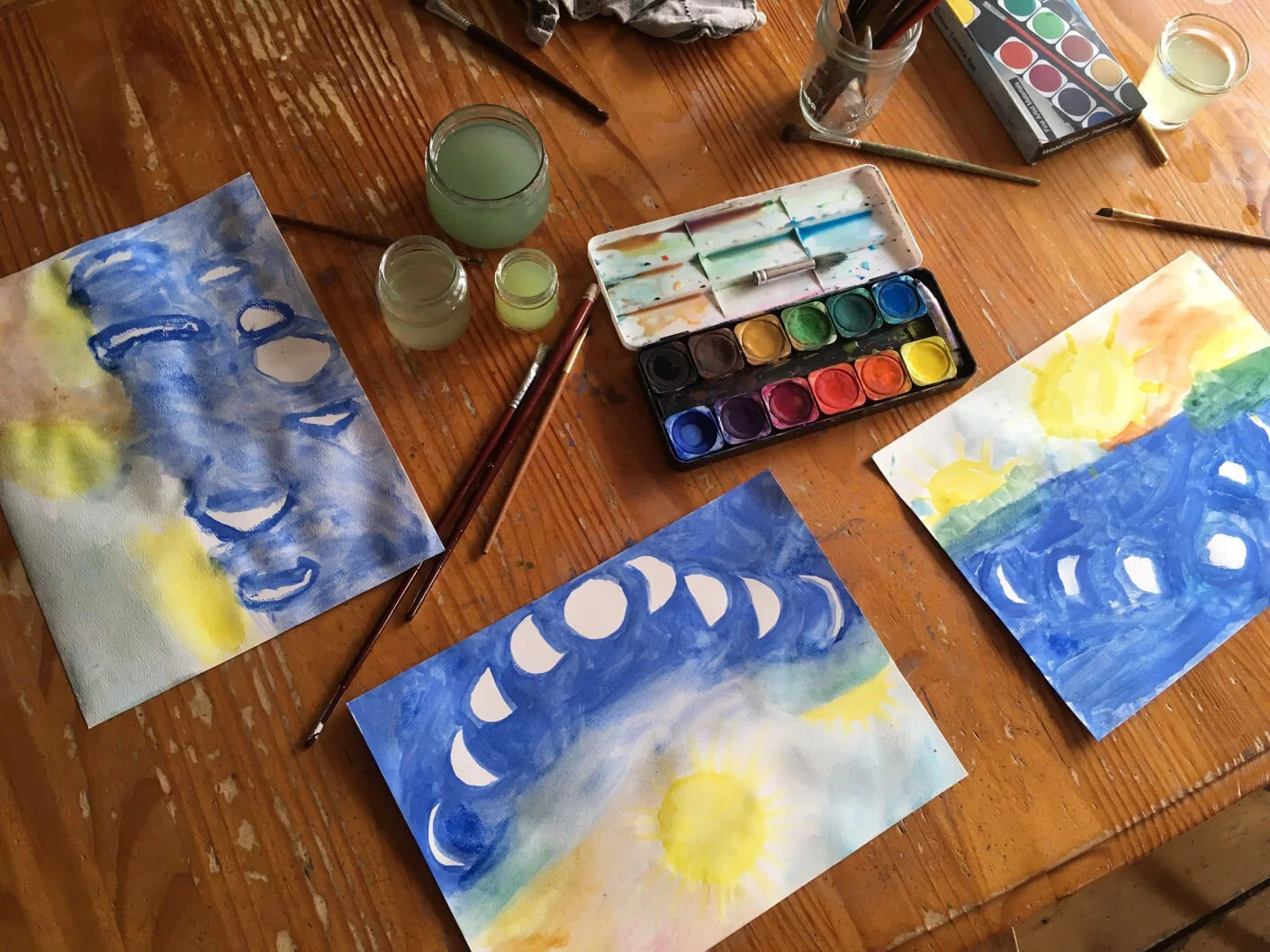
My kids really appreciate a written list of expectations for the day, including both school work and chores. This is also the time of day that we go over any outside-the-home-plans or activities. For years, we would then move on to circle, but as my crew is getting older I’m struggling a bit to settle into what works. We seem to be transitioning to a singing and devotional time for everyone, then first grade movement or song, which my boys surprise me just often enough by jumping in and wanting to join in!
GIVE US A SNAPSHOT OF ANY MANAGEMENT/ORGANIZATIONAL STRATEGIES THAT ARE HELPING YOU FLOW THROUGH YOUR HOMESCHOOLING DAYS.
This year I’ve got three kids in the grades, and although it is different than the year of juggling babies and toddlers with school, it is still a juggle all the same! I find the more we can combine lessons and find overlap the smoother our days go. My fourth grader is equally passionate about ancient history and sciences as my sixth grader, so I only need to alter the length of their writing assignments.
My daughter, on the other hand, really needs her time with fairy tales and the foundations of academics, so I have to be careful to fill her bucket. As far as organization, I have tried quite a few methods. Last year, I printed out everything we would need for the year from various curriculums and online resources, and had my own open-and-go curriculum. It was, in many ways, lovely, but I still tweaked it and rearranged it so much that I'm back to my tried and true classic of just making lists.
The lists for first grade are simple, lists of letters with stories and ideas, lists of math games, lists of read alouds and handwork and art projects. For the boys there are lists of books and projects for each block. Then I have always kept a very informal mental check list for full school days to includes the three R's (reading writing and arithmetic) and something beautiful. If the three R's aren't covered in main lesson, then we will cover them in short independent review for my older ones, and in games or songs in the younger grades.
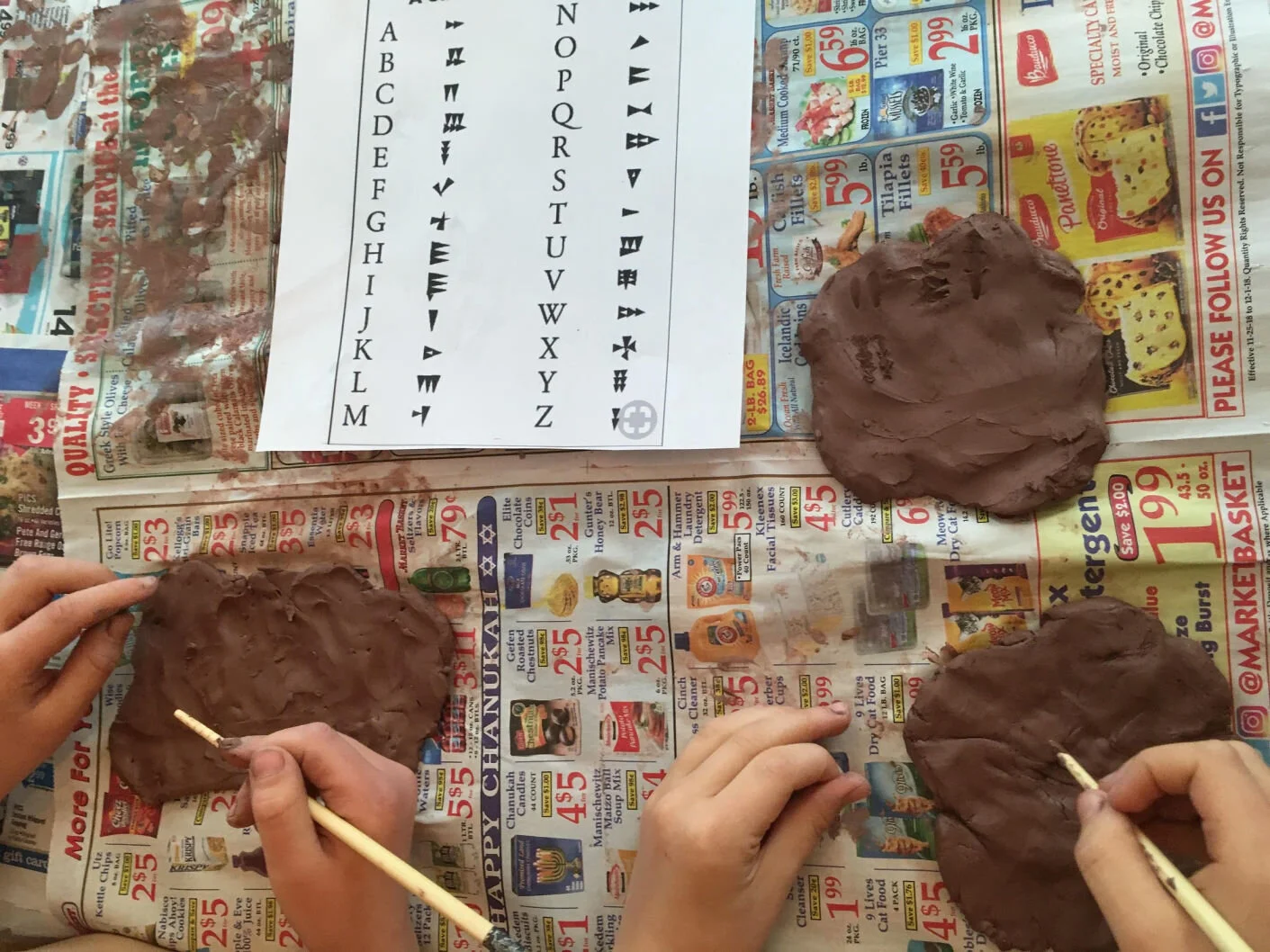
Using lists works well so that school can happen around living life. We can enjoy good weather days and say yes to field trips and spontaneous play dates without feeling behind or like we need to rush through lessons to catch up. If the next lesson is a three day project but it’s a Friday, we can just pick a different shorter lesson, we don't lose momentum just because we aren't ready for the next thing.
The last thing I utilize that helps keep us going, is planning for the times that I can't be the awesome hands-on teacher that I like to be. They do review days with independent work like math, spelling or cursive copy work books, piano apps, art lessons and math games.
“The goal is that school fits into our life and gives us structure when needed rather than force our life around a school schedule.
”
WHAT ARE SOME OF YOUR FAVORITE RESOURCES? (HOMESCHOOL OR OTHERWISE)
Oh I have so many favorites! As someone who doesn't tend to stick to curriculum but loves reading it for ideas, it’s probably no surprise that I love buying individual blocks from places like Hearth Magic or Ancient Path on Etsy, or blocks from a Waldorf Journey or Magic of Waldorf.
I’m a big fan of the mathbyhand.com Times Tables and Fables Kit, the Living Music from the Heart for recorder, and Out Door Secrets from Simply Charlotte Mason. I always enjoy pursuing book lists from Waldorf and Charlotte Mason curriculums to find the best books. And of course, I love the inspiration from other moms on social media, but I’m not sure I’d be able to do this at all without my real life, in person, homeschool mom friends! I’m also very grateful for the Earthschooling curriculum for such a broad selection of stories for each grade which really brought a sense of freedom to our home school.
WHAT ARE YOU CURRENTLY READING?
I’ve always got a more challenging classic going that I'm half listening to on Libervox - right now it’s Anna Karenina by Leo Tolstoy, which will take me a full year. I’m also reading The Girl with the Pearl Earring by Tracy Chevalier, and I found a 50 cent copy of Beyond the Rainbow Bridge by Barbara J. Patterson and Pamela Bradley that I am enjoying, even though my kids are past this stage. I was wanting something Waldorfy after reading The Brave Learner by Julie Bogart and Mere Motherhood by Cindy Rollins this summer. As a family we are reading Rosemary Sutcliff’s The Odyssey and Swallows and Amazons by Arthur Ransome, I highly recommend both! I just started A Mathematician’s Lament by Paul Lockhart and it’s so great! A must read for any educator!
WHAT DO YOU DO WHEN YOU ARE OVERWHELMED OR STRESSED?
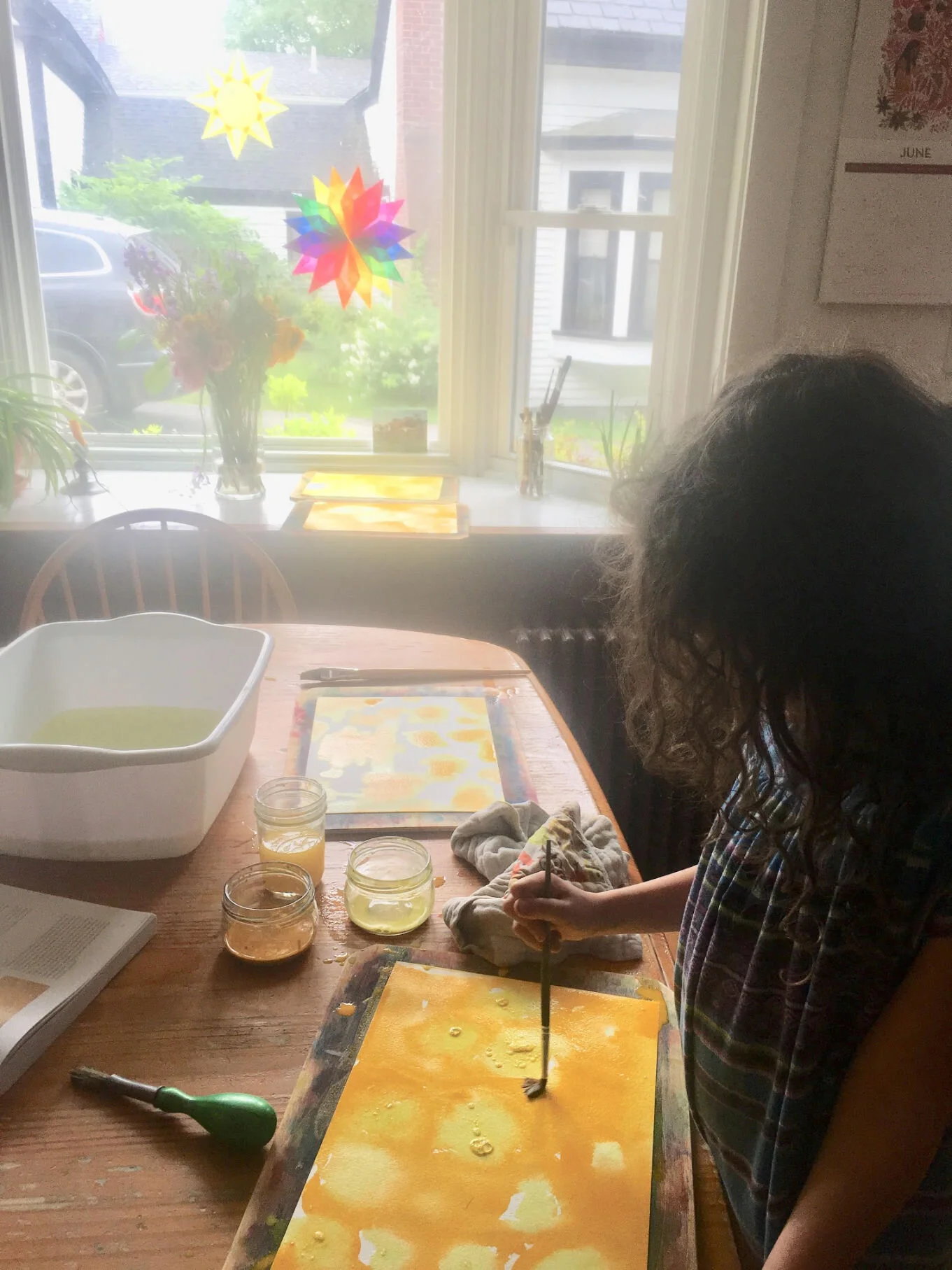
When the overwhelm comes I know it is time to slow way down with school and outside-the-home commitments. It’s a balance because sometimes the overwhelm comes from needing to catch up on house work and adult work, and so it makes sense to put everything on pause to get those caught up. But other times the overwhelm comes from business, and I find creative pursuits and time in nature and daily time in prayer and meditation are such a good antidote to business. I also feel very blessed to be able to take about 5 hours a week of ballet and modern dance classes and it’s so nice to have that built in time to be totally in my body.
PLEASE SHARE SOME WORDS OF WISDOM YOU'VE GLEANED OVER THE YEARS.
There are always those new stages where it is really tempting to think, "Wow my kid is so big, it’s time to really hit the books," or "This school year has got to be really rigorous". But I keep coming back to the idea that school needs to be fun or we are doing it wrong, and it is just as true in sixth grade as it was in kindergarten. Leaving breathing room is paramount both for creative teaching, to stay aware of the climate in our home that is set by our attitudes. It is far more important to prioritize relationships and character.
TELL US A BIT ABOUT HOW WALDORFISH COURSES ARE ADDING TO YOUR SCHOOL YEAR. READY....GO
So far we have enjoyed the Waldorfish courses that are a part of the Earthschooling membership. Waldorf art was such a game changer for us, especially for my oldest who was so afraid of making a mistake that he wouldn't write or draw or paint at all.
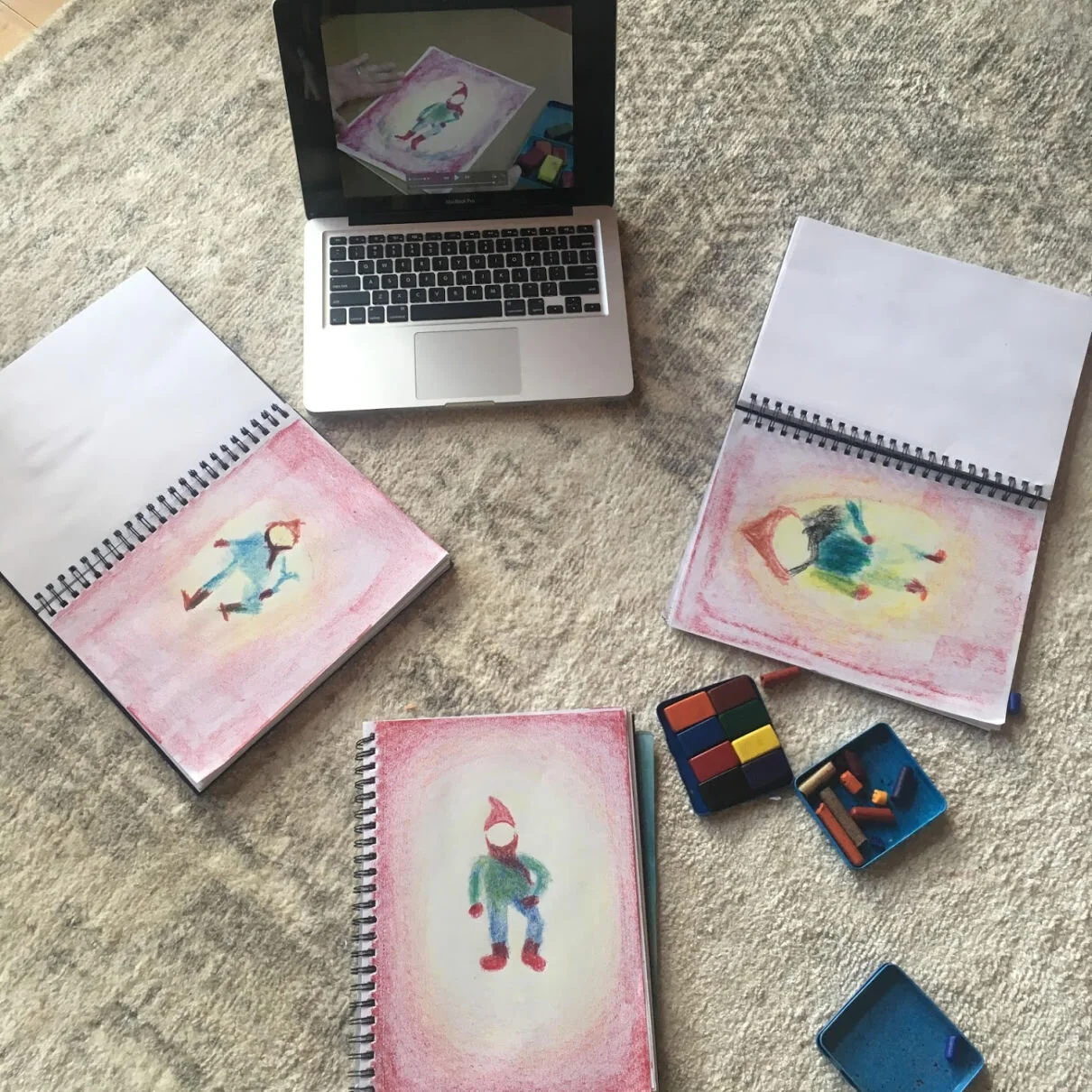
“The course on block crayons showed me how to teach how forgiving drawing could be. I’m so glad I didn’t give up, and that we found the Waldorf arts - that I found something that teaches art as a skill that can be improved. ”
My sons are finally really happy with their art, so we are now working our way through the courses again as a family but this time with little sister joining us!
WHERE CAN WE CONNECT WITH YOU?:
Instagram: @cheyenne_and_crew
Related Content:




Waldorf Form Drawing in Grade Four
Now that we reach fourth grade in this progression from first grade, we find that the wholeness has separated into parts.
(*Didn’t read the last post? No worries! Find out more about third grade form drawing here!)
The fraction is an archetype for fourth grade.
The teacher leads the child to experience the fraction and return it to the whole. Just so, woven forms provide the same journey. Woven forms are perhaps the most recognizable elements of Waldorf form drawings, though the woven form has been an artistic theme in various cultures for millennia.
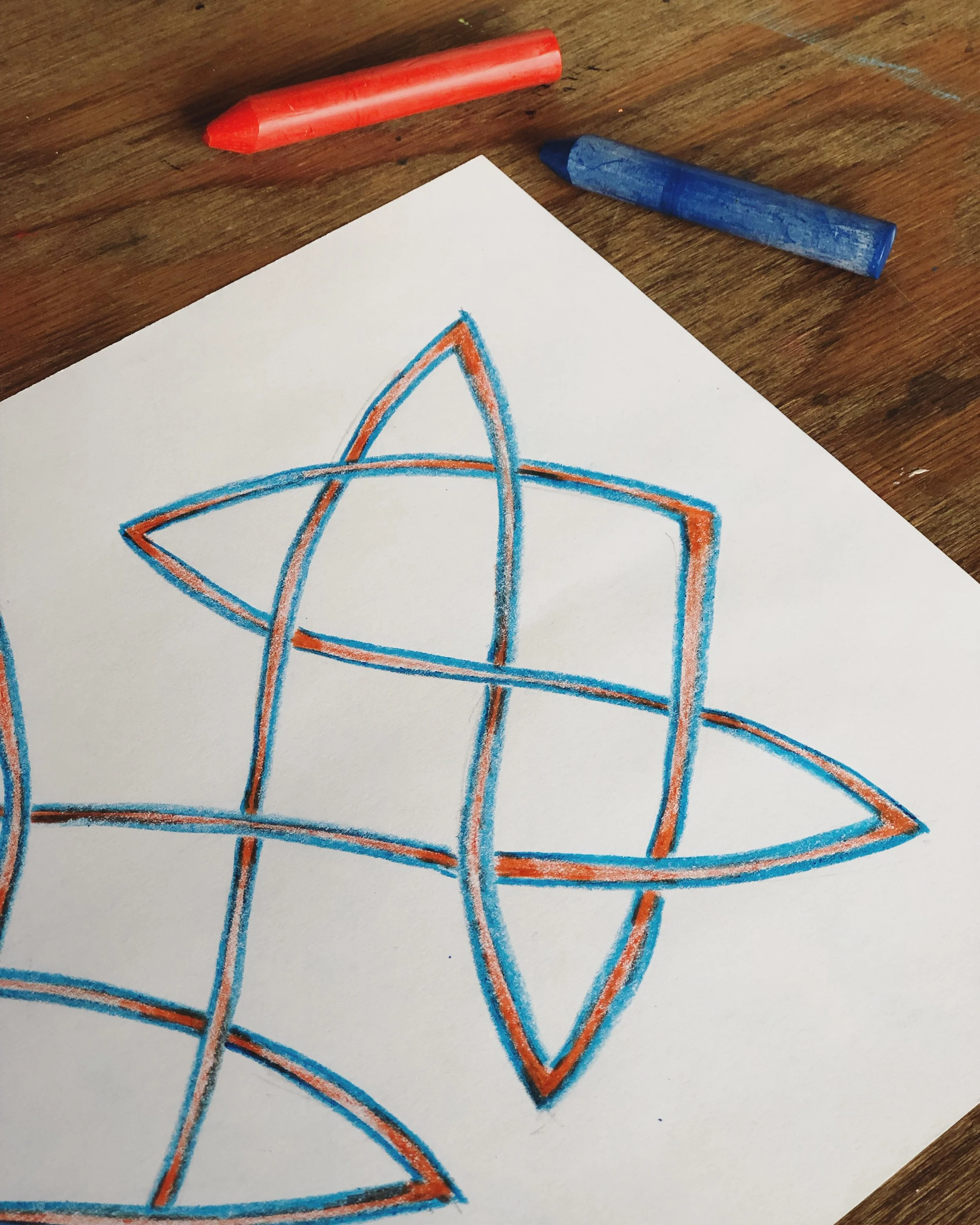
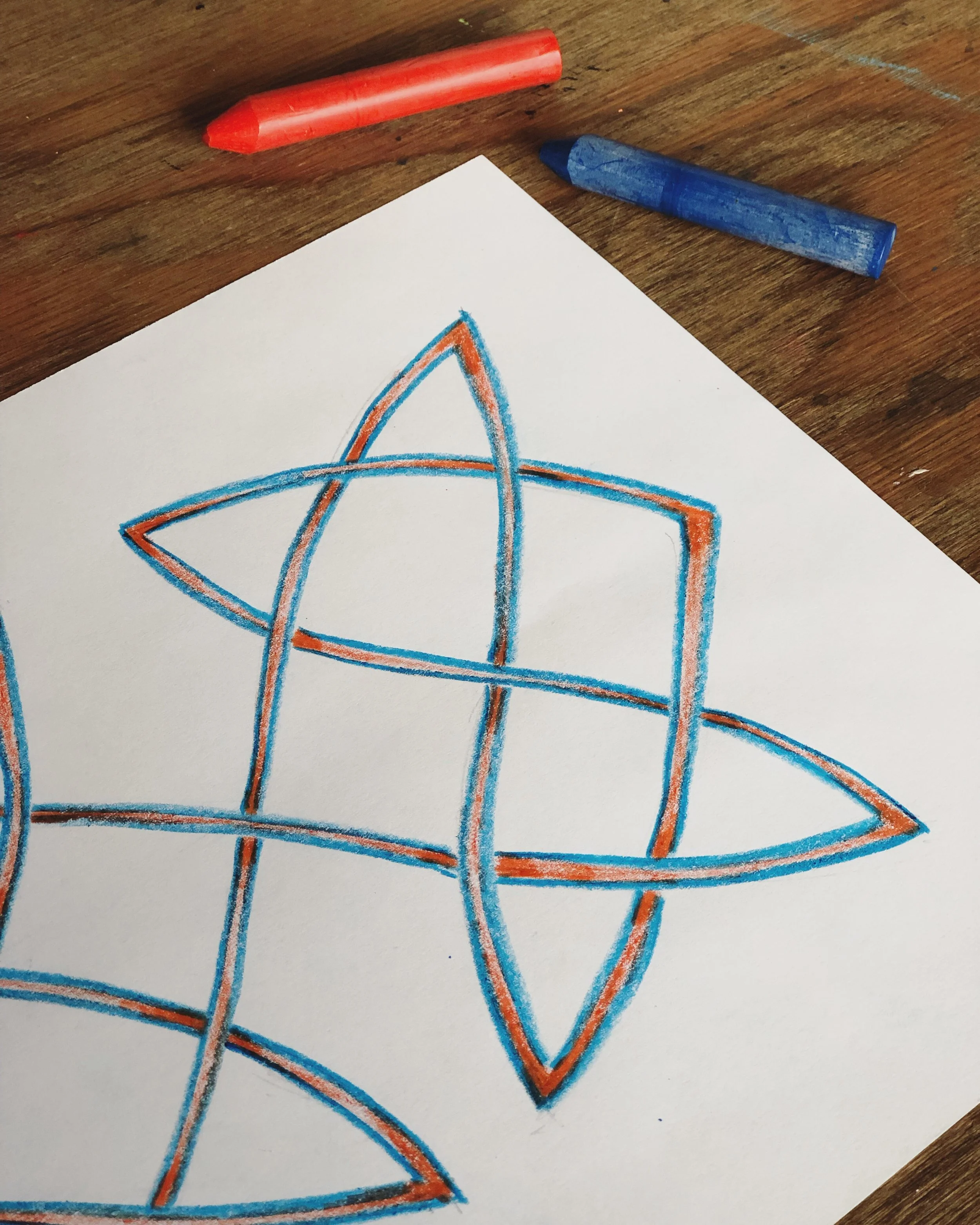
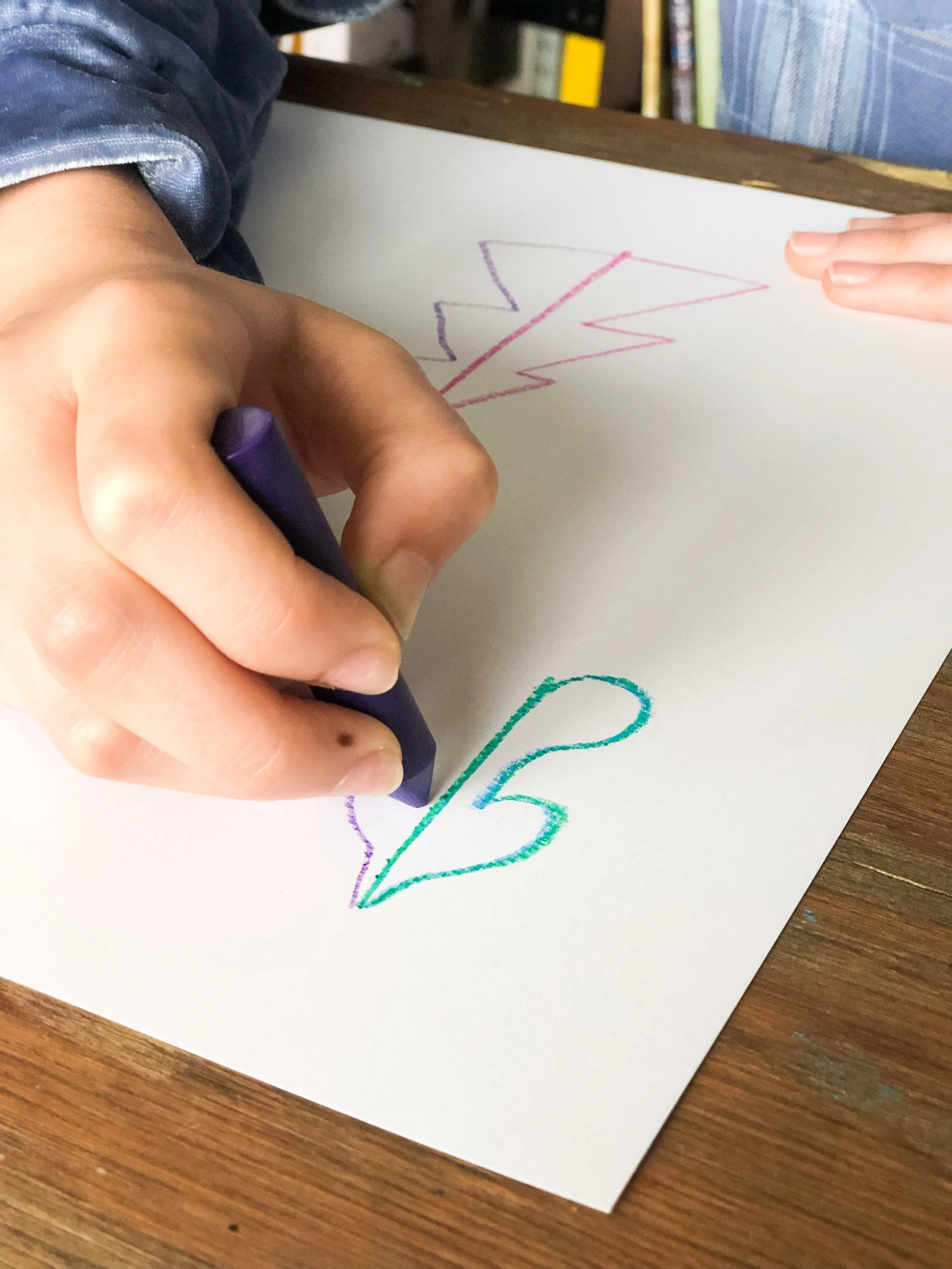
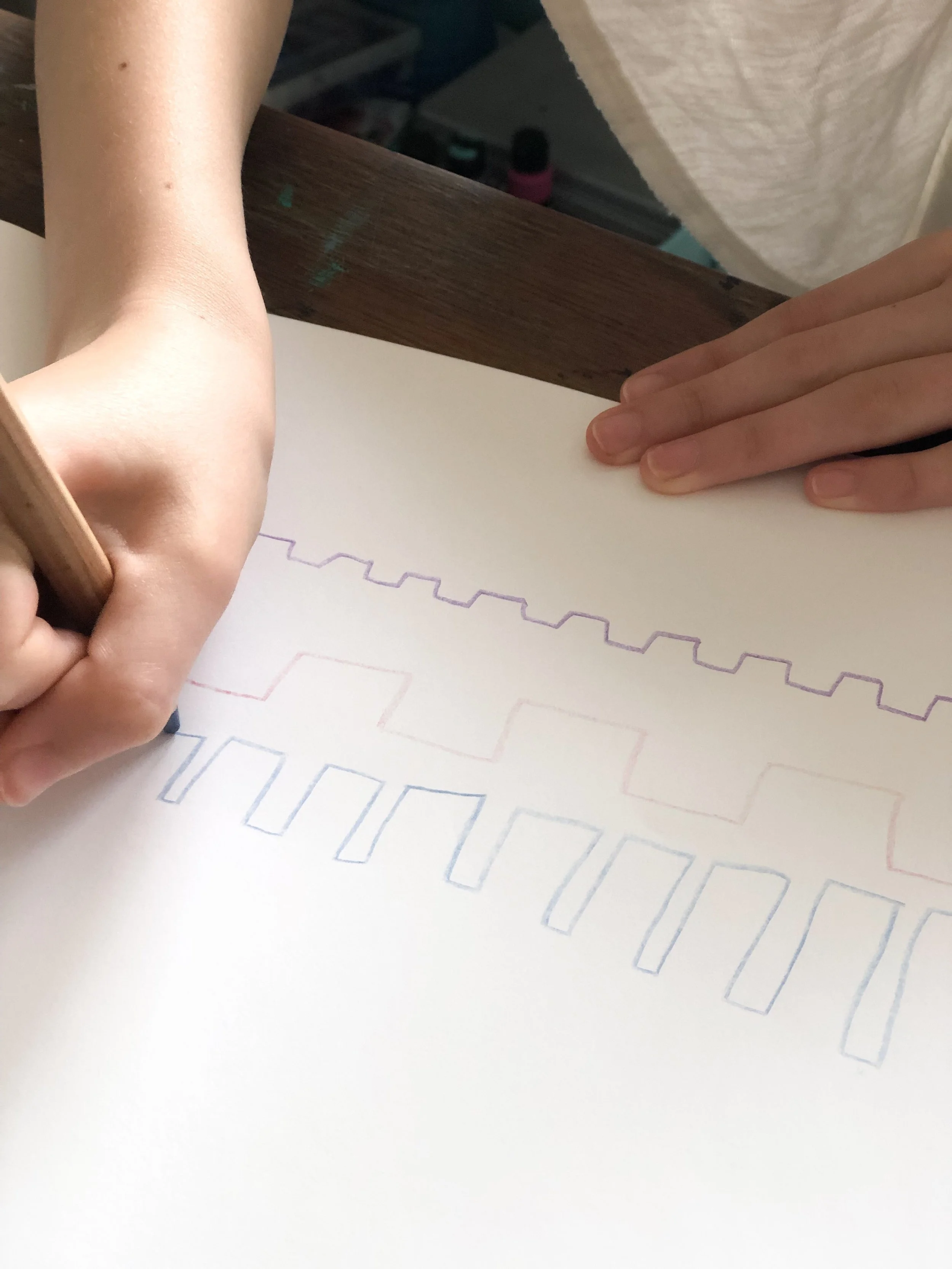
A beautiful woven form creating with crayons.
Fourth grade forms
With the woven form, we take the line and fold it back onto itself, perhaps even with multiple lines. We create a beautifully ordered knot. We weave a fabric. To render this in a drawing requires us to fragment the whole line into many different line segments so that we give the impression that the line has indeed woven itself over and under, over and under. We take the one line and divide into many fractions, but we arrange those fractions so that there is a new one-ness realized. Whether these woven forms are arranged in circular, triangular, or rectangular fashions, there is almost always an inherent geometric foundation evident in the whole.
Likewise, we can also take basic geometric shapes and explore an ordered division of their spaces so that we create equivalent fractions that are both beautiful and true. Each of these free-hand form drawing activities bring us ever closer to an experience of pure geometry. It is important to allow the student to struggle with the realization of these forms with the freehand approach first. Allowing the child to struggle with crawling, standing, and walking builds valuable will-forces that serve the human being throughout life. So too the struggle with geometric forms is a valuable learning experience that builds powerful inner faculties.
Rudolf Steiner urged the first Waldorf teachers to awaken “what will become geometry later—but first, one should keep it all in the realm of freehand drawing.” (Lecture 10, Practical Advise to Teachers).
The drawings and activities of these fourth grade form drawings have their own intrinsic value and can fill a lifetime of exploration in and of themselves. However, as a step on the curricular path, they are also leading toward the fifth grade year of freehand geometric drawing.
Grades 1-4 Form Drawing are OPEN for enrollment.
Related content:





Waldorf Form Drawing in Grade Three
Third grade is very often a time of tremendous change for children…
…and thus it can require that we make tremendous changes in how we meet them.
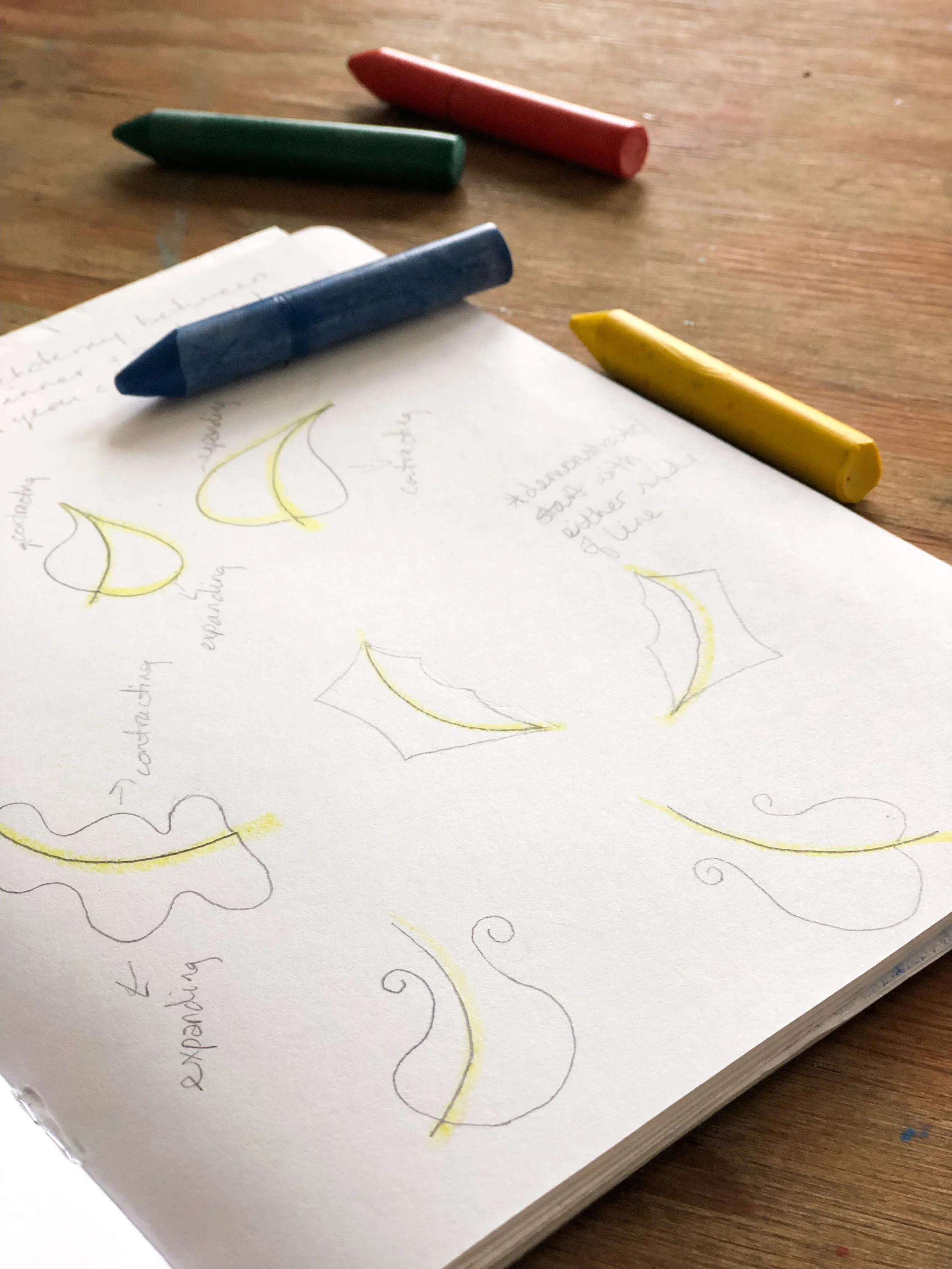
Form drawing in grade three (teacher training notes)
There is perhaps no more archetypal image that can help us understand the third grade child than that of any creation mythology in which the human being, once united with the Creator, now finds himself separated, forlorn, and bereft. The developing consciousness of the 8-9 year-old begins to have a sense of separateness. There is now an awakening sense of an inner world. The signature of one-ness that holds and sustains the young child is lost. It is a dramatic and necessary step toward individuation. So, the third grade elements of form drawing incorporate this experience.
Forms in third grade
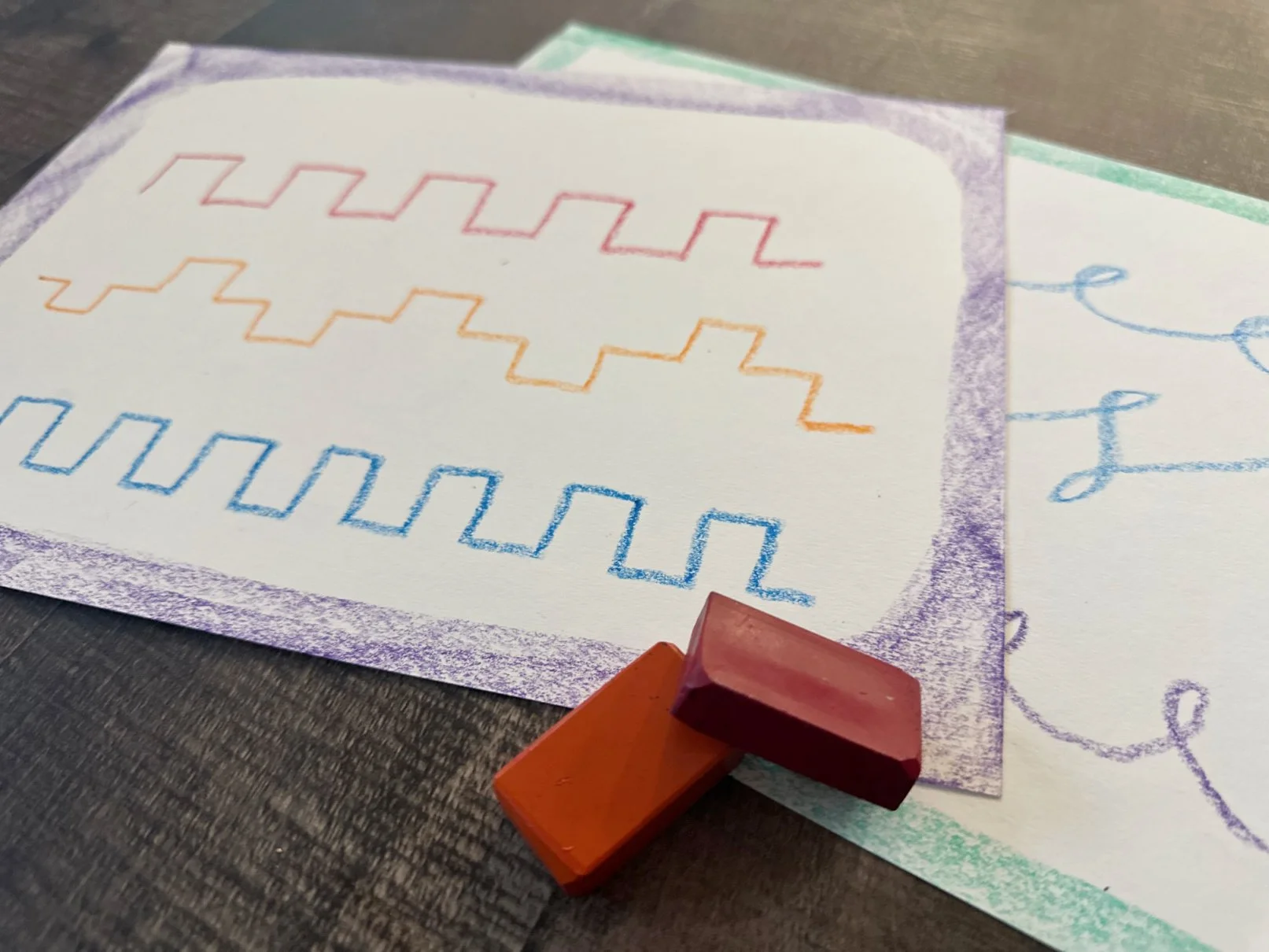
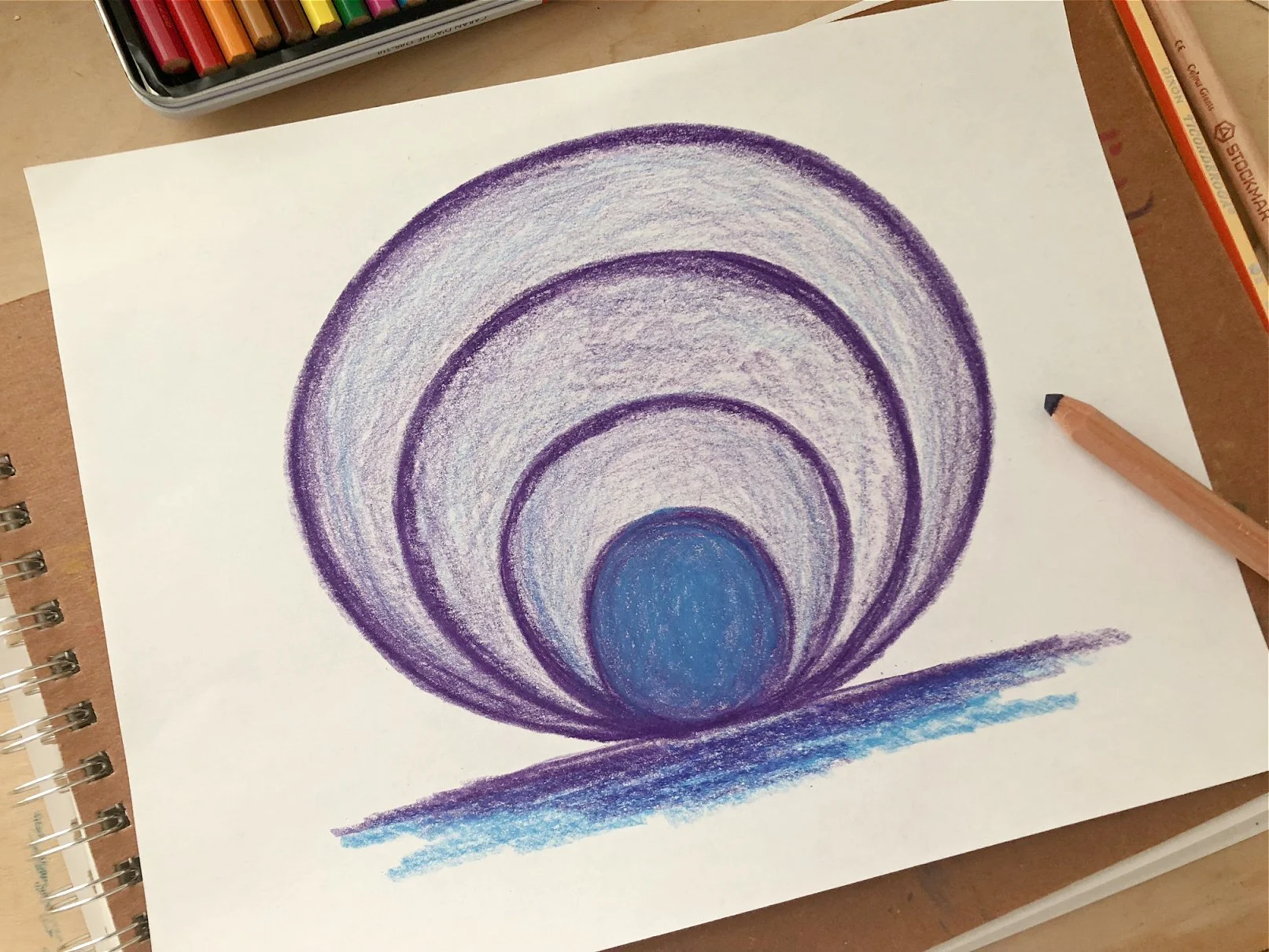
Now we work with forms that explore relationships and change. We bring about forms that challenge us to explore and create new harmonies. This is an exciting time because the forms that we set up for the child can be balanced in many different ways. There is not a “perfectly correct” answer. The “rightness” must be felt by the child and by the teacher.
Learning to live as an individual on the earth is a constant exercise of attempting to find harmony in new ways as new elements arise in our lives. So, the teacher can be as creative in providing new “quests” for the student and then remain open to the practically infinite possibilities that the child has for discovery of corresponding forms. This has a mutually-inspirational quality that provides a lift to the child who struggles with this new sense of the bigness of the outer world and the isolation of the inner world.
“They should be given sufficient space to engage in the process in an exploratory manner. If this is achieved, a rich opportunity for differentiation and mutual inspiration is created.”
Peter Giesen, Form Drawing Workbook
Learn more about our Form Drawing series for homeschooling families and class teachers.
Grades 1-4 are OPEN!
*Click the button below to read about pricing and payment options.
Related content:
Waldorf Form Drawing in Grade Two
While we continue many of the same kinds of forms explored in first grade, we begin a new impulse in second grade.
Click here to read an introduction to this topic, as well as Rev’s piece Form Drawing in Grade One.
The second grader begins to experience a vague sense of duality or polarity in the world. For this reason, the second grade stories told in Waldorf schools will revolve around the tales of human virtue, such as those of the saintly beings from various traditions, as well as the tales of lower nature, such as those found in Aesop’s Fables.
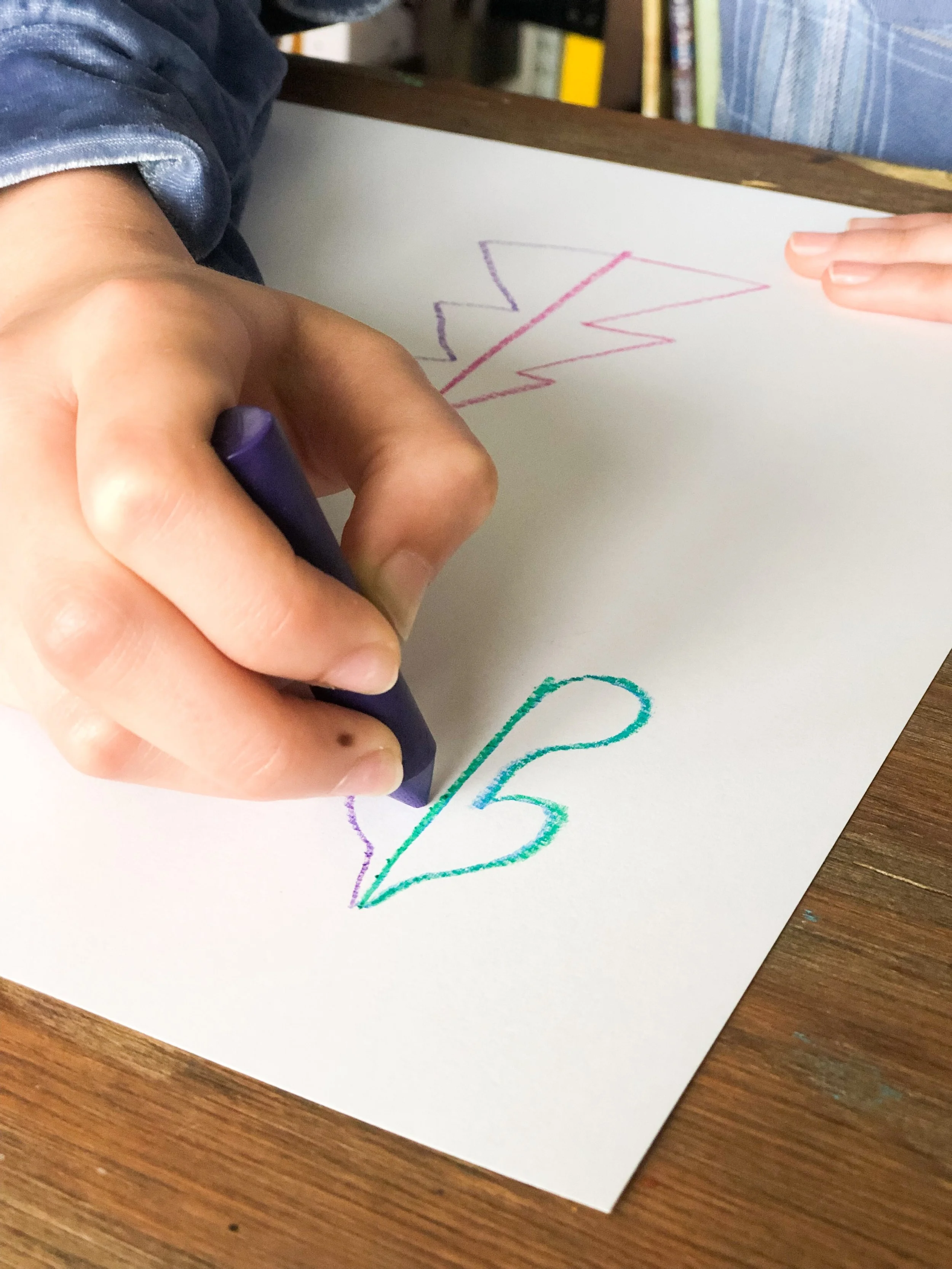
Vertical symmetry in grade two form drawing.
The child is only dimly awakening to these same qualities in the world and within herself. So the stories provide an imaginative realm of soul in which such themes may be explored. Likewise, there are movements and forms that can provide a similar exploration and arena for discovery. It is important to note that the Waldorf teacher will not end a fable by explicitly recounting some abstracted moral. It is important to allow the child to “digest” such lessons herself.
With the movements and forms, we would also not muddy the child’s experience with some intellectual explanation of its value.
We simply bring the movements and forms for the child for her experience. We trust the profound wisdom at work in the cosmos and in every human being. We do not need to explain this “soul digestion” any more than we need to explain our physical digestion in order for it to happen after a meal. We simply bring them new movements and forms that provide an even more direct experience of the above and below, the right and the left, and the cross-lateral.
Rudolf Kutzli, in his book Creative Form Drawing, reminds us that this inherent power of Waldorf form drawing “leads to an activating process of unfolding creative forces that lie dormant in every human being. It speaks to the inner rhythms that bring harmony to the forming and dissolving, the challenging and quietening, the cosmic and earthly in the human being. It thereby strengthens the very center, the ‘I’ between the constant threat of tendencies toward sclerotic thought, barrenness of soul, and the aimlessness or apathy in the whole sphere of the will.”
Learn more about our new Waldorf Form Drawing series for homeschooling families and class teachers.
Enrollment is OPEN!
Related content:
Looking for something?

Welcome to Waldorfish! We started this adventure in 2012 out of a desire to make Waldorf training more accessible to class teachers in remote locations and to homeschooling families everywhere! Read more, click here.




WE WON! Our Weekly Art courses were voted “best interactive art program.” Learn more about the award, here.


Click here for a full list of schools we work with.
A few of our most popular blog posts:

Who are our courses for?

Starting Waldorf First Grade

4 Things to Know Before Planning Your Homeschool Year

In Praise of Balance: A Healthy Festival Life
Science in Waldorf Middle School: Starting Something New!