
Waldorfish Blog

Waldorf education won't fit in a box (Part III).
You may have noticed that we don't think a good Waldorf education will fit in a standard sized box.
More importantly, it will not necessarily resemble what our Waldorf friends and neighbors are doing either. We HIGHLY recommend asking yourself a couple of questions before you make any decisions related to your children. Consider:
“Is this toy (or school supply or activity, etc) helping to nurture a spiritual depth and creative thinking within my child?
Do we currently own something that can be used to the same end?
Could we make/do something similar ourselves?”
What is most important?
Brian and I have spent the past couple of years distilling our decades of experiences in classrooms down to the most essential components.
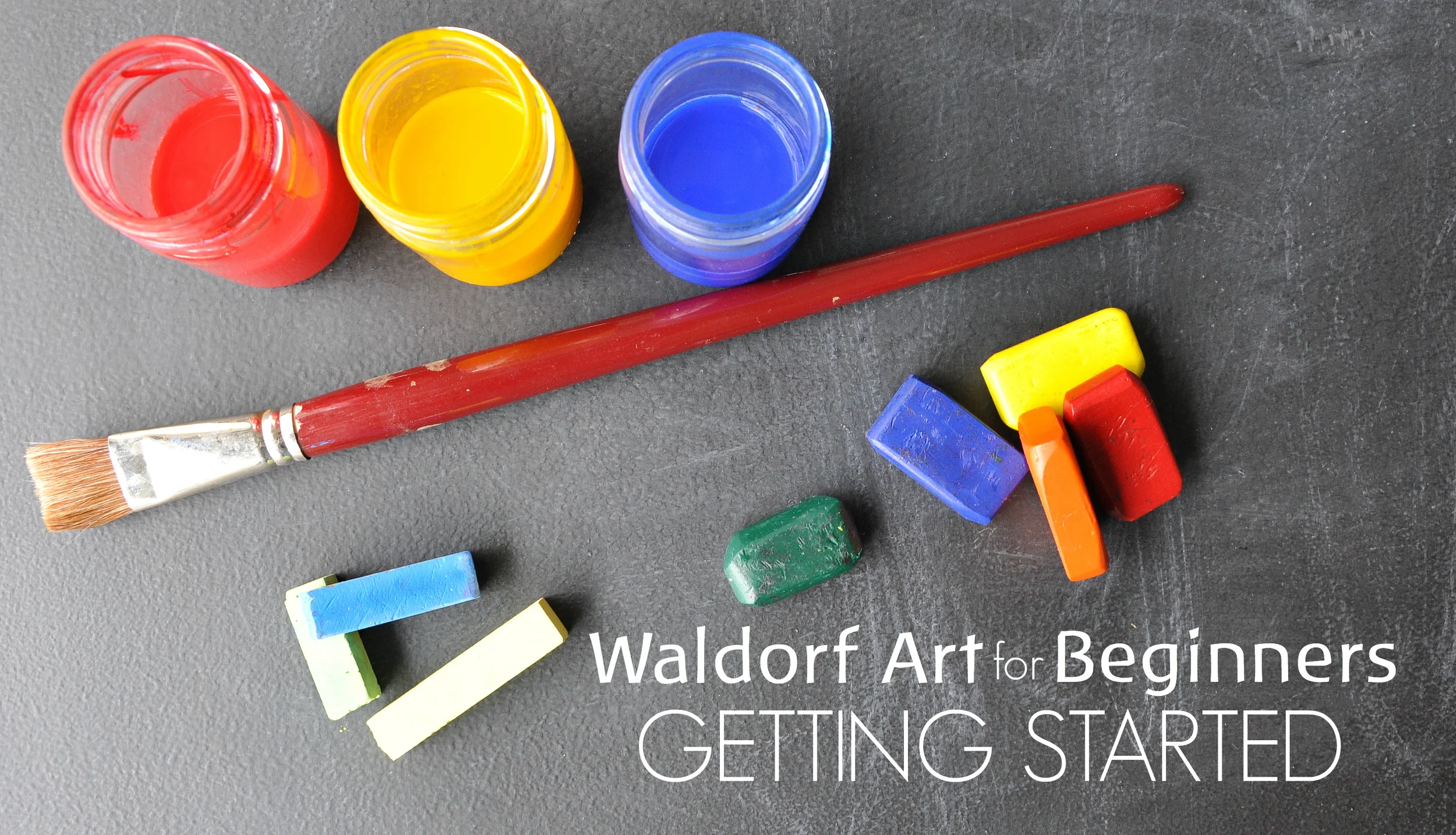
We’ve been looking at what is really important. For example, our online course, Waldorf Art for Beginners, is one product of this distillation process.
While planning it, we asked ourselves:
What art tools and supplies does a family just getting started with Waldorf education really need?
What’s worth spending money on, and what’s not so important?
What are the most basic skills they’ll need to move forward with chalk-drawing, watercolor painting, and using block crayons?
The results of taking the time to reflect on these questions is a course that is JAM-PACKED with value, and yet is still simple. Filled with ease.
Take a minute to reflect on what is most important for your family. What do you really need?
Claim your quiet.
What would more simplicity look like? Find the ease.
What does a balanced weekly rhythm look like for YOUR family? Are you doing more than feels good because you feel like you need to look like other Waldorf-inspired families?
Let's cheer each other on as we move towards creating more simplicity in our days, our weeks!
It's so worth it.

Freedom! (or, Advice for your Waldorf journey, Part II)
My inner pragmatist spends a lot of time contemplating what she can tell you that will be immediately useful to you on this journey.
It's true that yes, this is a journey of many steps, and ultimately there's no rush. But there is also the reality of needing to jump in and get started somewhere, yes?
So, maybe it makes sense to start here?
I am 100% certain that Steiner never said we should go broke giving our children a Waldorf-inspired education and lifestyle. He did say that we should emphasize natural materials, and that teachers should consciously choose open-ended playthings and supplies for the home or classroom that will nourish a young child’s senses. It’s true, sometimes the toys and supplies made from beautiful, natural materials DO cost more, and well, rightfully so. They are often handmade, and they are worth more than their plastic counterparts, plain and simple. This leads me to my next thought.
It isn't always going to look the same.
At no point did Steiner ever say that we must buy all the same things that other Waldorf-inspired families own. Nor did he say that we must teach our children in exactly the same way. In fact, he was pretty clear about that,
“According to each teacher’s individuality, outer forms of teaching may vary enormously in the different classes, and yet the fundamental qualities are retained...in a Waldorf school outer forms do not follow set patterns, so that it is quite possible for one teacher to teach his class of 9 year olds well, while another who takes a completely different line, can be an equally good teacher…and as long as the teacher feels in harmony with the underlying principals, and with the methods employed, he must be given freedom in his work instead of being tied to fixed standards” ~ Rudolf Steiner
Freedom!
What a relief, yes? There is so much freedom to be gained here, when we remember that the expectation was NEVER that we would all "do" Waldorf in exactly the same way.
Inhale.....exhale. And, repeat.

Advice for your Waldorf Journey, Part I.
We love the enthusiasm that comes with new endeavors, planning for a new school year especially.
Since childhood I've had a special place in my heart for school supplies. Anyone else out there that used to play "school" constantly?
High 5's and chest bumps!
As a class teacher, and now home-educator, the dialog as I'm planning for a new year (at least in my head) goes something like “Ok! Here we go! Let’s DO this!”. I like to picture a few high fives, and maybe some chest bumps too, although I’m not certain how Waldorfy those actually are. In any case, at some point in the planning process you, like me, are probably reminded that …. there are a lot of decisions to make.
Curriculum! Toys! Local classes! Art Supplies! Hurray! So many great options available online these days.
So. Many. Options. Oh boy.
Why did I buy this?
No doubt at one point or another, you have found yourself pondering just HOW one is supposed to weed through all the available information out there? Maybe you spent just a little more time than you meant to looking at all the gorgeous toys for sale online? Maybe you've spent just a little more money than you meant to? Or maybe a lot? Does anyone else still have a few things collecting dust from the early homeschooling days that were purchased in a flurry of enthusiasm, but then never actually got used? In my case, a spectacularly expensive, gorgeously handmade wooden puzzle comes to mind.
See? It’s ok. You’re not the only one.
Take your time. Bring good chocolate.
You are probably already somewhat familiar with Rudolf Steiner. No doubt you are aware that he had a lot to say about Waldorf education. Like, A LOT, a lot. It seems to me that no matter where you are in this journey, there is plenty of time to work your way through his lectures, slowly and thoughtfully. My advice would be to keep good chocolate nearby, and pace yourself.
Remember, this is a journey :) Take time to savor even (especially) the tiny moments!
More soon,
~Robyn

*Read Part II :: Freedom!
New here? We've got free goodies for you!

Black and White - Art in the middle grades
The Waldorf art curriculum is smartly designed to meet children where they’re at in each phase of their development.
If we provide children with the right tools at the right time, the whole experience nourishes them on a deep level.
In the early grades (1-4) students live in a playful artistic realm. The experience of playing with colors and finding basic form is more nourishing than technique and detail.
Students use art as an extension of their imaginations and the stories they hear. Around fifth grade, students are learning about ancient civilizations and how art was used as a method of communication and story telling. From early cave art to the hieroglyphics of Egypt and the mandalas of ancient India, the painting and drawing styles were full of imagery and color. Early art tends to also be fairly two dimensional. It's primary purpose was to tell a story, honor the gods, and represent culture. This is perfect for a child (such as the average 5th grader) who is on the verge of puberty but still lives in the imaginative world of childhood (learn more about fifth grade curriculum here!)
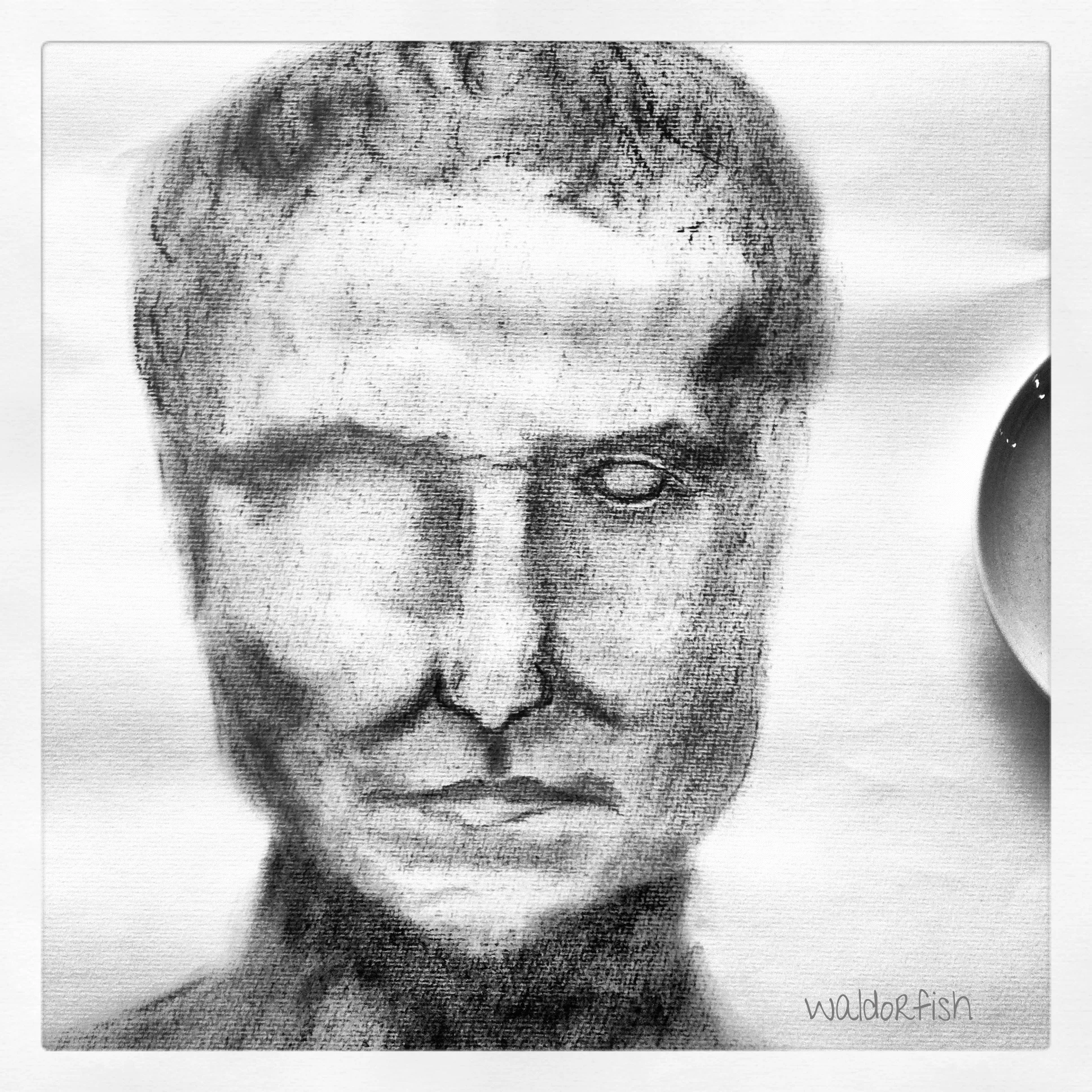
Charcoal drawing is a work in progress- it’s about the process, not the result!
As puberty sets in, the child moves away from the colorful imagery of these ancient peoples into a world of realism and perspective. From the beginnings of civilization and the golden age of Greece the curriculum moves toward the fall of Rome as children enter the 6th grade. Their arrival in Rome begins the next phase of artistic expression.
Teaching art (or any subject!) in the middle school is challenging yet meaningful work.
Students generally are starting to compare their own work with that of others. They are also realizing that they are very different from each other. Each student is on his/her own journey both internally and externally. Most of us remember the battles we faced each day in middle school. The inner struggle to understand how and why the body is changing is contrasted by the outer struggle to find one’s place socially. The child is thrust into a world of polarity. These polarities are often expressed verbally by middle school students. “I HATE my drawing!” “This is SO TOTALLY fun!” “My teacher has NEVER liked me!” “This is the BEST class!”
There may be no better way to meet this moment in their development than to introduce the polarities of black and white drawing along with the multitude of greys that come with studying the nuances of light and dark.

Light and shadow working together!
Students begin to study optics in Physics and using a phenomenological approach are encouraged to look at the world as infinite expressions of light and dark. By learning to see light and shadow and positive/negative space, elements of realism and depth begin to emerge. 6th graders are also generally hungry to learn technique. “It doesn’t look right” is the most common complaint I hear from middle school art students.
Their ultimate goal is to make their drawing match what they see (either in reality or in their mind’s eye). Learning how to effectively use lines and shading helps the students become better able to draw what they see, as everything we see is based on relationships between light and dark. Black and white drawing, with it's emphasis on using lights and darks to shade & add depth, is the best way to help them begin to achieve more realism in their art work.
This new skill meets the children perfectly as they are beginning to see their social environment through their own internal polarity lenses. Things are fair or not fair, someone is telling the truth or they are lying. That experience was either the BEST, or the WORST.
Sound familiar?
Emotions tend to run hot and cold at this age. Socially, students tend to feel “in” or “out.” As teachers, we strive to have the experience of the grey scale between light and dark be therapeutic for them, on a deeper unspoken level. While black and white is the main theme at the start of adolescence, the shades of gray in between hint at the next stages of complexity in the development of the human being. As students move beyond the 6th grade towards the end of middle school, vanishing points will expand artistic horizons and bring an entirely new perspective in the grades to come.
~Brian Wolfe
**Looking for some black & white drawing inspiration? We made a Pinterest board for you loaded with resources and ideas!
Looking for something?

Welcome to Waldorfish! We started this adventure in 2012 out of a desire to make Waldorf training more accessible to class teachers in remote locations and to homeschooling families everywhere! Read more, click here.




WE WON! Our Weekly Art courses were voted “best interactive art program.” Learn more about the award, here.


Click here for a full list of schools we work with.
A few of our most popular blog posts:

Who are our courses for?

Starting Waldorf First Grade

4 Things to Know Before Planning Your Homeschool Year

In Praise of Balance: A Healthy Festival Life

Science in Waldorf Middle School: Starting Something New!