Perspective Drawing - Art in the middle grades
Teaching perspective drawing to seventh graders has always been a highlight for me.
This is one of those magical moments where the curriculum meets the students everywhere they need to be met.
Thirteen year olds are always right.
Just ask them ;)
A seventh grader is desperately trying to form his or her own point of view and beginning to understand that we all see the world through our own, unique lens. The most important concept of perspective drawing is the establishment of point of view. In perspective drawing, the artist must constantly ask "how would this look from my perspective?"
(Looking for guided support teaching this subject? Our course, Weekly Art Diving Deeper includes a series of step-by-step Perspective Drawing Lessons!)
The Horizon Line
The horizon represents the limit to how far the eye can see, assuming we can look beyond the buildings, trees, and mountains that might be in the way. In perspective drawing, the horizon is a straight line that establishes the "eye line" or point of view of the artist. In reality, we know that the horizon is not straight because the earth is round. We draw it as a straight line because that's how we perceive it. (More on perception versus reality later)
It's fitting that a seventh grader should grapple with the idea of learning to understand the world between him/and the flat horizon which, in turn, begs the questions: "What's beyond the horizon? and... Isn't the world round?"
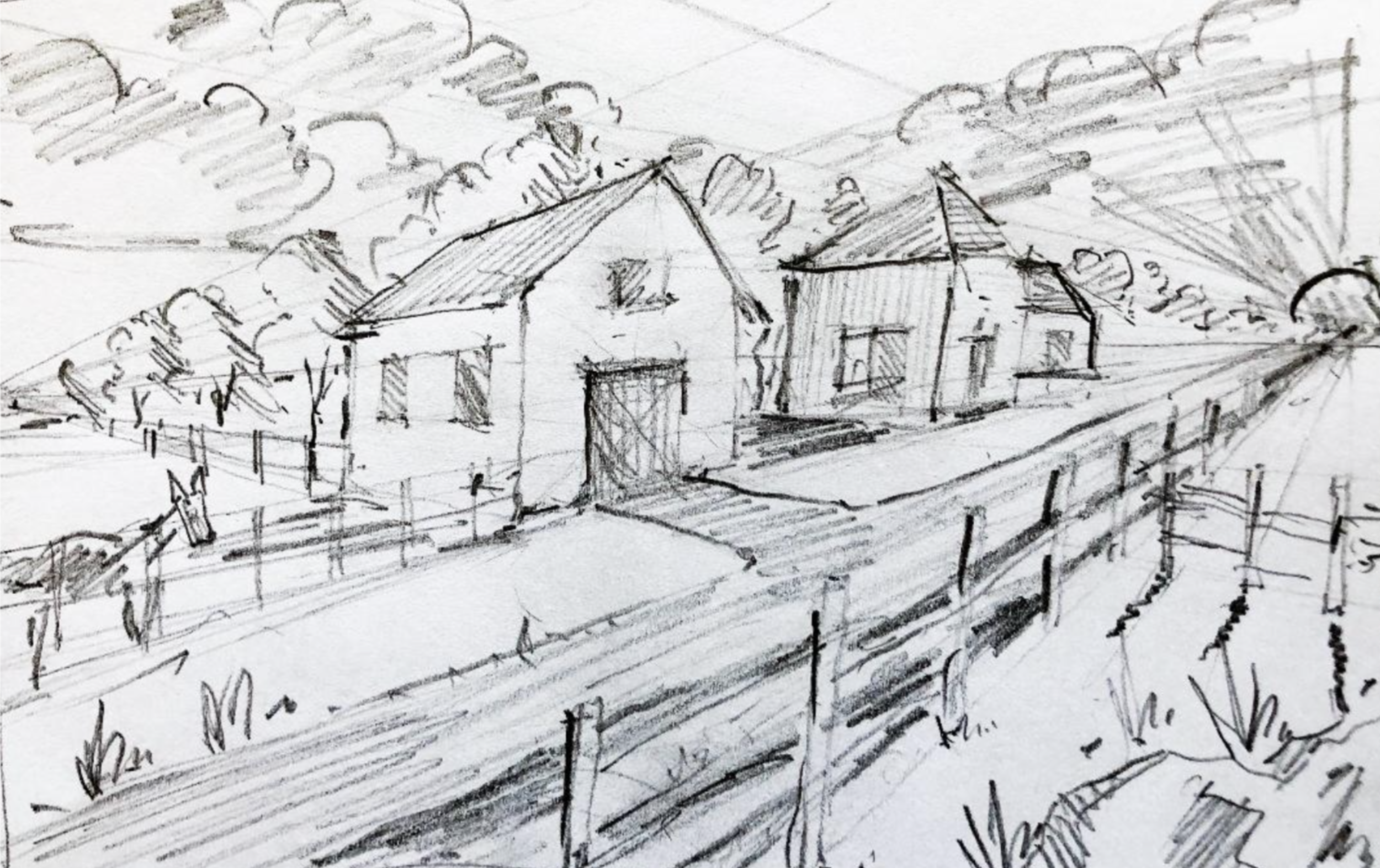
Depth, distance, and creating from a certain point of view: this is perspective drawing!
Vanishing Points
In the sixth grade, students are often satisfied with isometric three dimensional drawing. All of the lines of an isometric box are parallel. It looks real! Life gets a little more complicated in 7th grade, however, as the students move farther away from the simplicity of childhood. The typical seventh grader begins to question everything (especially the teacher!).
When it comes to teaching perspective drawing, I like to teach by asking questions. "If the sides of this cardboard box are equal in length and parallel in real life, why do they look like they're getting closer together as they go off into the distance?" Soon they discover that straight lines going into the distance appear to line up with vanishing points on the horizon. Now they are ready to construct rules for drawing the world as it appears to us.
On more subconscious level, there is another phenomenon at play. As human beings, we can venture beyond the horizon in the physical world, and we can explore the depths of our inner selves. The vanishing point on the horizon mirrors the vanishing point inside each human being. Interestingly, both the horizon and the vanishing points are not fixed.
They are simply boundaries placed by the artist based on his or her unique perspective at a single moment in time.
Art as metaphor for life.
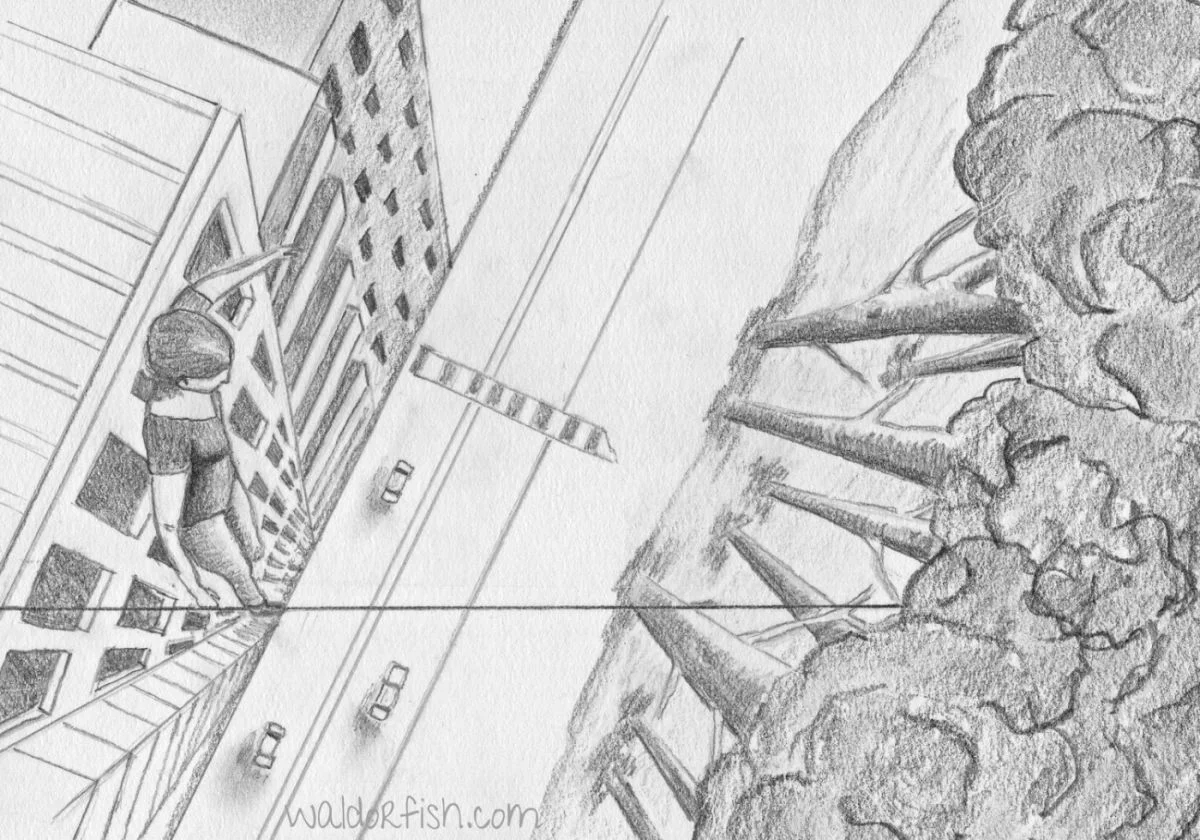
Why not try drawing from a different point of view?
Perception vs. reality
I love taking seventh graders through this journey of building a set of rules to create reality and then realizing that we need to keep bending the rules when a new piece of information is introduced.
"Why does it seem like there's more than one vanishing point?"
"Why does it seem like all the vanishing points change in reality when I move my eyes?"
"Is there really a point out there?"
Some students are happy to live inside the set of rules for perspective drawing and some edge closer to the idea that this set of rules is a convention that humans created. It's a method of taking our visual perception of the three dimensional world and putting it onto a two dimensional surface in a way that accurately represents the artists point of view at that particular moment in time.
The process is akin to learning a language in order to express your point of view. It's all the more valuable if our students can be guided towards developing this set of rules on their own. As they work with the drawing exercises, I encourage you to try not to give in to the temptation of TELLING them what they are experiencing. The questions that lead to the rules will naturally flow out of them if they are given many opportunities to EXPERIENCE the drawings!
—> Download Brian’s teaching notes, from his Perspective Drawing course for teachers at Rudolf Steiner College:
Content related to the middle grades: