
Waldorfish Blog
notes from a *mostly* media-free life :: real work
Most of the "real work" that shows up doesn't need much direction. It's given by the older kids, real needs and the rhythms of the day. It's expected, full of autonomy and often attached to a bit of authentic urgency that they rise up to address. A few examples from this week, along with a daily media exception:
Animals. Even while we travel we can't resist the care and keeping of little things. These crawfish live under the dock, but we haven't gotten around to making our own traps. So we buy them at the scuba shop for $2.50, scrounged up from under the cabin cushions. Of course, animals require a habitat, food, cleaning (and extra supervision/sometimes taking over)...
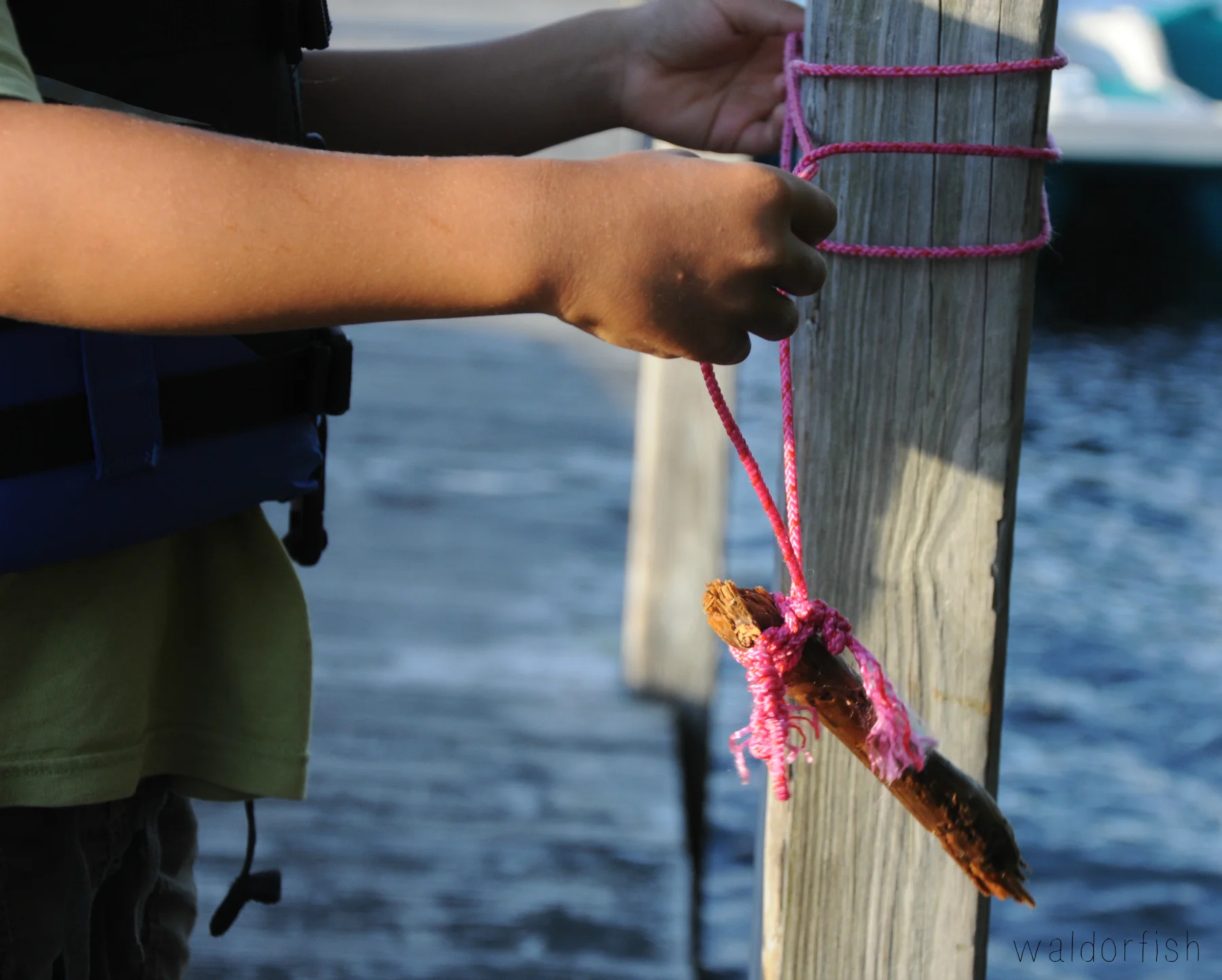
Tying the ropes. Where we live, there are no cars, only boats. So every child learns to jump out & tie the ropes by the time they're 3 or 4, and to dock, or "park," first with rowboats and kayaks, and eventually with motors and steering wheels. When the neighbor kids are all together, there's lots of compromise as they take turns playing passenger, driver, food service, and dock boy/girl. The dockers have to entertain themselves while they wait; sweeping, clearing, and teaching themselves every possible kind of knot.
City planners. Despite my best attempts to eliminate mini-economies that leave the little ones crying "broke!" my kids are all about creating currencies, roads, products, taxes & toll booths. (That's a toll booth on the tree) They trade poker chips, sticks, fishing lures, you name it. All good stuff, probably, it just requires an agreement that the big kids always make sure the little ones are provided for, and that they don't go overboard handing out comprehensive city policies. If I try not to pay too much attention, they pretty much walk around feeling uber-purposeful...
Laundry. Dishes. Table setting. There's not much argument when you have a community of others waiting on you (from them or us)...
Reverence. With an authentic, deep respect for the lake that feeds them, they troll the bottom for things that aren't supposed to be there. Like these sharp mussel shells, or smoothed out bottle glass. This is a cultural practice, picked up by imitating the big kids and a pastime that mimics dice-diving. If they happen to find a really nice bit of stick, these shells make great whittling knives for pulling out the soft parts to uncover lovely curves and interesting patterns.
Gathering kindling + firestarting. There's always a chance of squalls, even on the brightest, hottest days, so there needs to be a solid stack of wood, and baskets full of kindling. When they're little, we sing, "sticks for the fire, sticks for the fire. We're gonna get some sticks for the fire." As they become strong and fast, it becomes a race to find large branches, which get propped against granite and stomped on, creating instant piles of kindling. Once inside, they learn to build the fire: crumpled paper, plenty of kindling, three small logs placed straight ahead, three across, and two straight ahead. Obviously, this particular job is tightly linked to an innate sense of honor. Do we let them light it? Of course.
At this point, everyone is tired. Full, and used up. In every house here there's a similar scene: candles on the table, with family members playing cards, drawing, reading, knitting, or fixing something. Maybe some bickering. At our place, the chef du jour is always blasting a playlist of songs we love - a huge mix of 70's singer-songwriters, world music, 80's alternative, do wop, 90's R&B, country, and old-skool hip-hop. It never fails to surprise me when they know every word to Kenny Roger's "the Gambler." There's more media mixed in to our daily rhythms.
And it is what it is. Waldorf-modern. How do you include media in your daily life? xx. Maya
Does this describe your family? Click to Tweet!
We live *mostly* media-free. And there's media mixed in to our daily rhythms. It is what it is. #waldorfmodern #waldorfish
little hints of Fall...
We found this beauty ripening under her leafy vine this morning, out in our front yard garden.
homegrown butternutty goodness
Fall is definitely on her way, and thank goodness for that! I'm having a hard time waiting patiently.
One of the (many) exciting aspects of growing Waldorfish is meeting like-minded people from all over the world (Europe, Asia, Australia, India, S. America, oh my!) I suspect that those of you in the Southern Hemisphere must be getting excited about welcoming your Spring back.
Whatever your vantage point, may you enjoy all the little hints of *your* changing seasons.
xo~Robyn
notes from a *mostly* media-free life :: free forage diy
Check out great-great Aunt Winnie's field guide, a gift for her 12th birthday from my boy's great-great grandmother, Ida. Given that we've been living in "Gram's" for the last two months, and Aunt Winnie just passed on to the heavenly realms, this find deserved some kind of new tradition.
Obviously, we'd need to leave the Flower Guide behind, lest it compost on path.
Oh, but the usefulness. And simplicity. {I find myself coveting all manner of vintage catalogues at this point...surely they must have things like this for covered bridges, sewing machines, shoes...}
Not for the kids, but simply for me, I posted these pipe mushrooms we found on Instagram, and @Shamanaflora promptly told me that they're not mushrooms, but parasitic plants that don't create chlorophyll, related to blueberries (heath family).
The dialogue begins...
Blueberries!! And then, oh, yes, they do feel like the parasitic plants I know from the Southeast Asia, clinging to every tree. And then...but wait, what are they feeding off of?
Enter this antique floral pocket encyclopedia: decayed leaves + dead trees.
I hope you all find these kinds of answers just as fulfilling as we do.

FREE FORAGE. Field cards for 5th grade botanical illustrators. Or collaborative family jaunts in the woods. Or compulsive paper crafters.
simple kraft envelopes, easily made with paper bags
textured paper. this is recycled elephant poop. oh, yes. www.poopoopaper.com
Long before coloured chalk.....
It's been almost two years since Brian & I first started talking about creating chalk-drawing tutorials. We spent a lot of time searching to see what kinds of resources already exist out there for teachers. We didn't have any interest in re-inventing the wheel. Many weeks of exploring different leads led us down several rabbit holes, most of which ultimately went nowhere. Except one....
you'll feel like you won the lottery!
I remember the day I stumbled across this beauty on the internet. I distinctly remember pointing emphatically at my laptop screen and yelling "why didn't anyone tell me about this??!!" As I looked through the pages (you can download this book for FREE here) I began seeing 1,001 different applications for class teachers, homeschoolers & artists.
Whitney was not a Waldorf teacher. He was simply a teacher with an immense appreciation for what beautiful imagery adds to the classroom. Interestingly, coloured chalk was not available for use yet. Whitney worked exclusively with the tones that exist between black & white.
Although the original copyright is 1908, there are still copies of this gem around. Being a bibliophile, I had to be able to feel it (and smell it!). I tracked down my 1911 copy on Amazon.
Our Black & White tutorial series is dedicated to Frederick Whitney and is available in our shop. In it, Brian mixes some of Whitney's instruction with his own and leads viewers to be able to create their own stunning black & white landscape drawings.
xoxo- Robyn
Looking for something?
Welcome to Waldorfish! We started this adventure in 2012 out of a desire to make Waldorf training more accessible to class teachers in remote locations and to homeschooling families everywhere! Read more, click here.




WE WON! Our Weekly Art courses were voted “best interactive art program.” Learn more about the award, here.

Click here for a full list of schools we work with.
A few of our most popular blog posts:

Who are our courses for?

Starting Waldorf First Grade
4 Things to Know Before Planning Your Homeschool Year

In Praise of Balance: A Healthy Festival Life
Science in Waldorf Middle School: Starting Something New!