
Waldorfish Blog

Waldorf Seventh Grade Chemistry: Starting with the Basics

Students learn by doing in Waldorf science!
Seventh grade marks a significant turning point in a student's development.
As young adolescents begin to think in more complex and nuanced ways, they become ready to explore subjects that require both careful observation and emerging abstract thinking.
Chemistry is especially well-suited to this stage.
It invites students to look beyond what can be immediately seen, ask deeper questions about the nature of matter, and begin investigating the invisible processes that shape the world around them. Through the study of chemistry, seventh graders are challenged to develop new ways of thinking while satisfying their growing curiosity about how the world works.

Hands-on learning is present throughout the Waldorf seventh grade chemistry block.
Unlike many sciences that can be directly observed in nature, chemistry asks us to look beneath the surface. Students begin to wonder: What is everything around us made of? How do substances interact with one another? What causes change?
The beauty of a Waldorf chemistry block is that no prior expertise is required, including for the educator! Students begin with direct experiences and observations, building a foundation from which deeper understanding can grow in eighth grade and beyond.
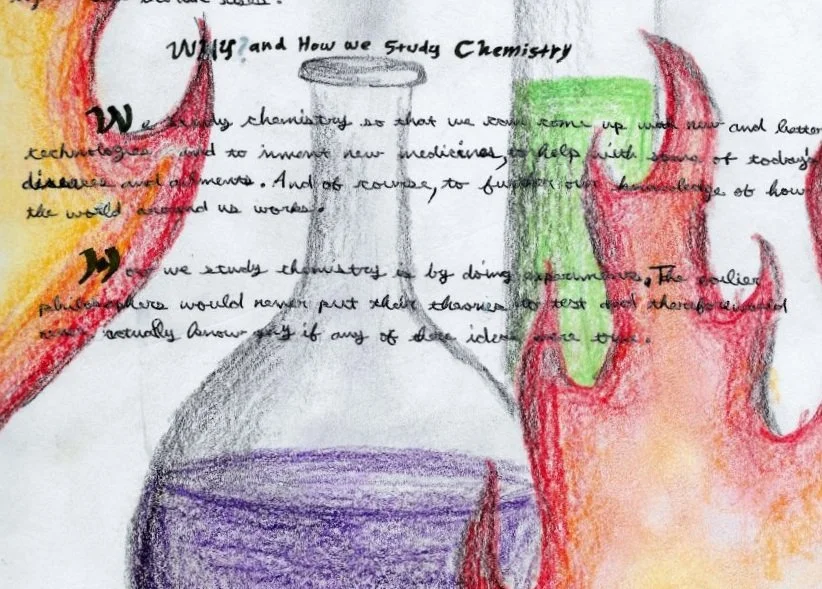
A central theme throughout the block is understanding the difference between physical changes and chemical changes. A physical change occurs when a substance changes its form or appearance but remains the same substance. For example, water can exist as a solid, liquid, or vapor, yet it remains chemically the same substance: H₂O.
A chemical change, on the other hand, produces a completely new substance. When wood burns, for example, it changes into ash, smoke, and gases. The wood is no longer wood at the molecular level - it has been transformed into something entirely different. Students learn to recognize and distinguish between these two important types of change as the lessons unfold.
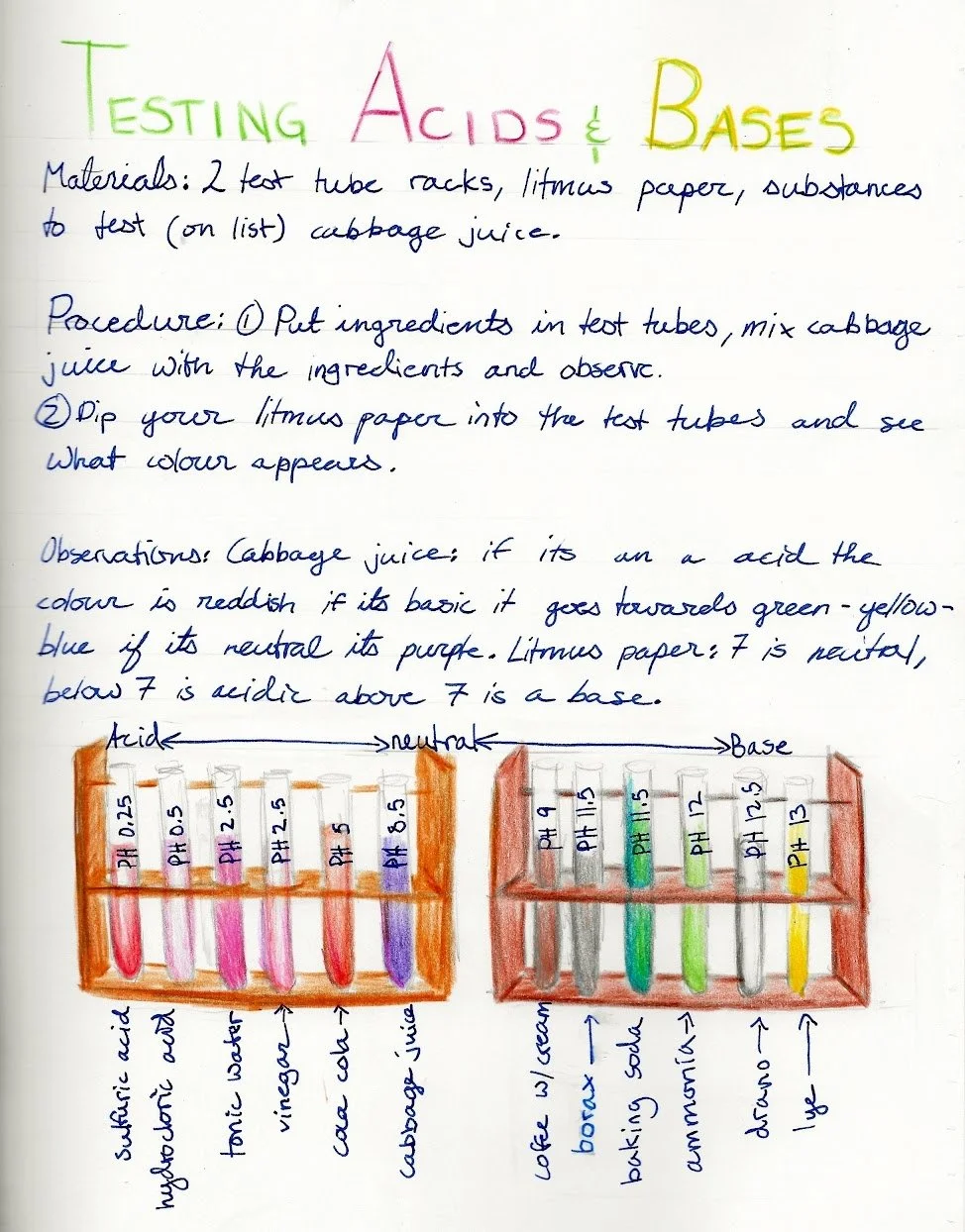
A student’s main lesson book illustrating their work with acids and bases.
Students explore the themes of the block through a variety of hands-on experiments and demonstrations.
During studies of combustion, they observe different materials as they burn, and discover how substances can produce colorful flames. Through crystallization activities, students create salt paintings and grow sugar crystals, witnessing how beautiful and orderly structures emerge from solutions.
The study of acids and bases brings another layer of discovery. Using purple cabbage as a natural indicator, students investigate how common household substances such as soap interact with acids and bases, revealing dramatic color changes that make invisible chemical properties visible.
The block often culminates with the lime cycle, a process that has connected human civilization to chemistry for thousands of years. Through stories, demonstrations, and observations of a lime kiln, students follow limestone as it undergoes a remarkable series of transformations, illustrating the interconnected processes of heating, burning, dissolving, and hardening.
Throughout the chemistry block, students are not simply memorizing facts.
They are learning to combine careful observation with emerging abstract thinking, developing the capacity to understand processes that cannot be seen directly. In doing so, they uncover a deeper layer of understanding about the ever-changing world around them.






About the Authors
Robyn Beaufoy is Waldorfish’s CEO, and also a course instructor for Simple Season, Waldorf Art for Beginners, and Weekly Art Foundations. You’ll find her intuitive touches and influences throughout everything Waldorfish offers. Robyn has been in the world of education for over 25 years, with an MA in Education and a certification in Waldorf teaching - she also homeschooled both of her children for some of that time. In 2012 Robyn co-founded Waldorfish.com, creating it with the vision ofmaking Waldorf inspired-art and pedagogy more accessible, joyful, and doable for homeschoolers all over the world.
Caitlin Amajor is Waldorfish’s course instructor for Geometry grades 5 & 6, Botany, and Geology as well as our Administrative Assistant. From a young age, Caitlin has been immersed in Waldorf education, attending a Waldorf school from K-8. After receiving a BA in History, Caitlin gained her certification in Waldorf teaching, and is a teacher in the upper grades. With a special fondness for watercolor painting and geometry, Caitlin loves bringing Waldorf education to her students all over the world, and seeing their own individuality and style bloom from the curriculum!

Waldorf Seventh Grade Physics Curriculum: Challenging the Laws of Nature

Waldorf Physics curriculum offers plenty of opportunities to experience the laws of nature!
Seventh grade physics curriculum in Waldorf education is designed to meet students where they are in their development.
Students at this age are beginning to be more critical of the world around them, pose difficult questions, and form steadfast opinions about almost everything. By bringing in the study of physics in a phenomenological way the students explore the laws and rules of nature, and are asked to think in more abstract ways. They are ready for something challenging, and the curriculum offers just that!
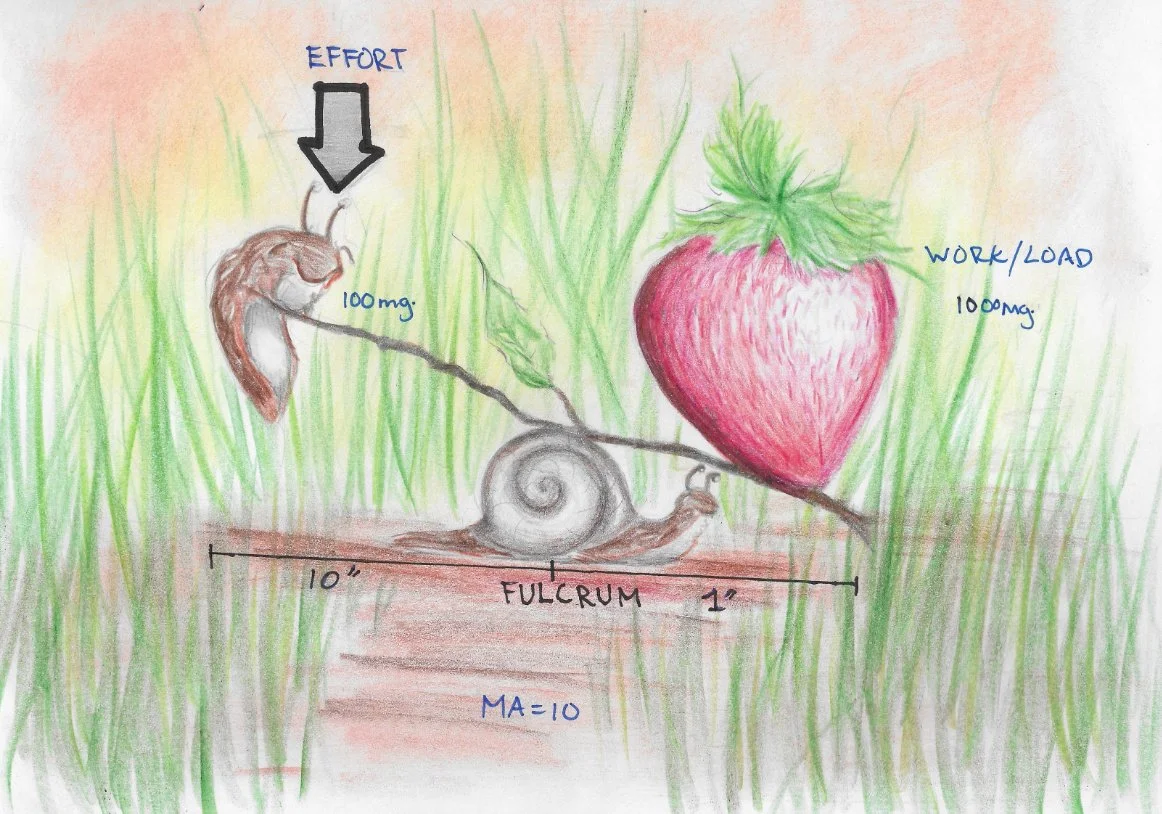
A central focus of seventh grade physics is mechanics through the exploration of simple machines: the lever, pulley, wheel and axle, inclined plane, screw, and wedge.
For each machine, students investigate how work is accomplished and how force can be redirected, multiplied, or balanced. This exploration is done by doing. Students may set up a pulley system to lift something very heavy; it is not uncommon to see a teacher’s car being lifted out in the parking lot! Other activities such as constructing seesaws, pulling a palette of bricks up a ramp, and building Rube Goldberg machines all provide the student opportunities to explore physics in the physical and analytical realms.
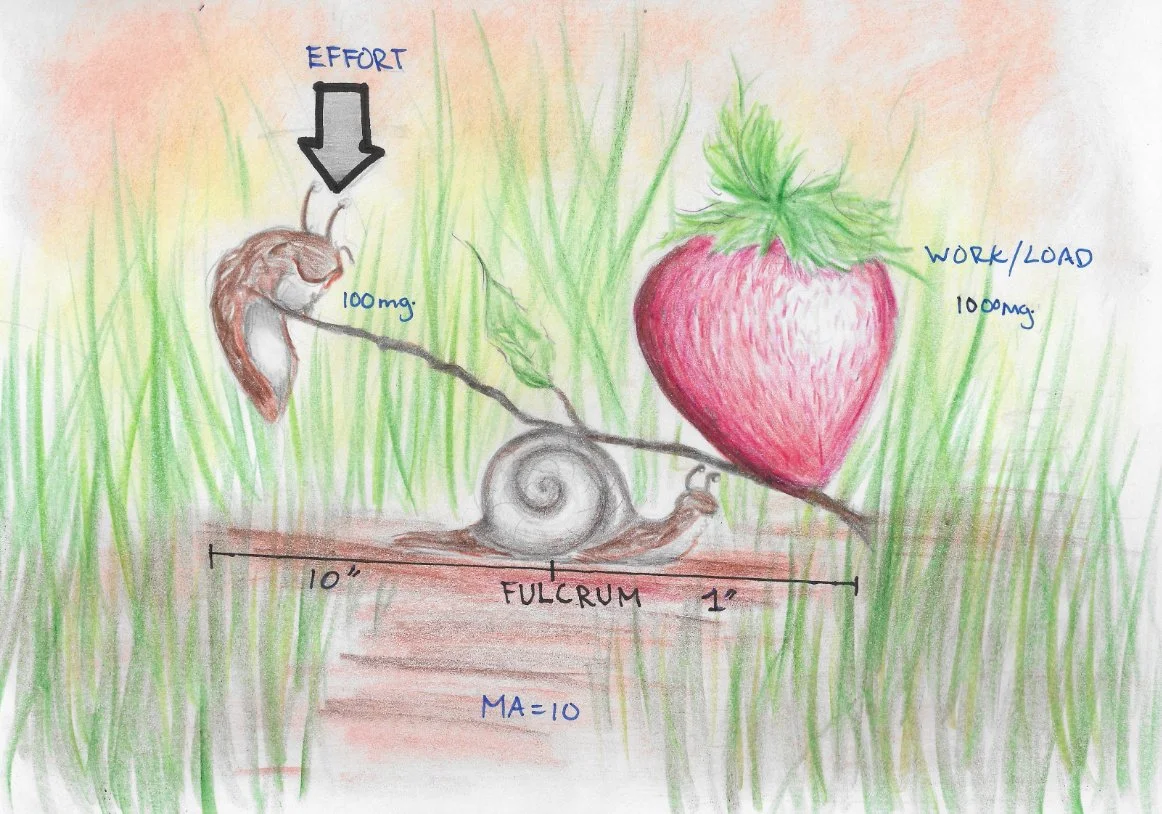
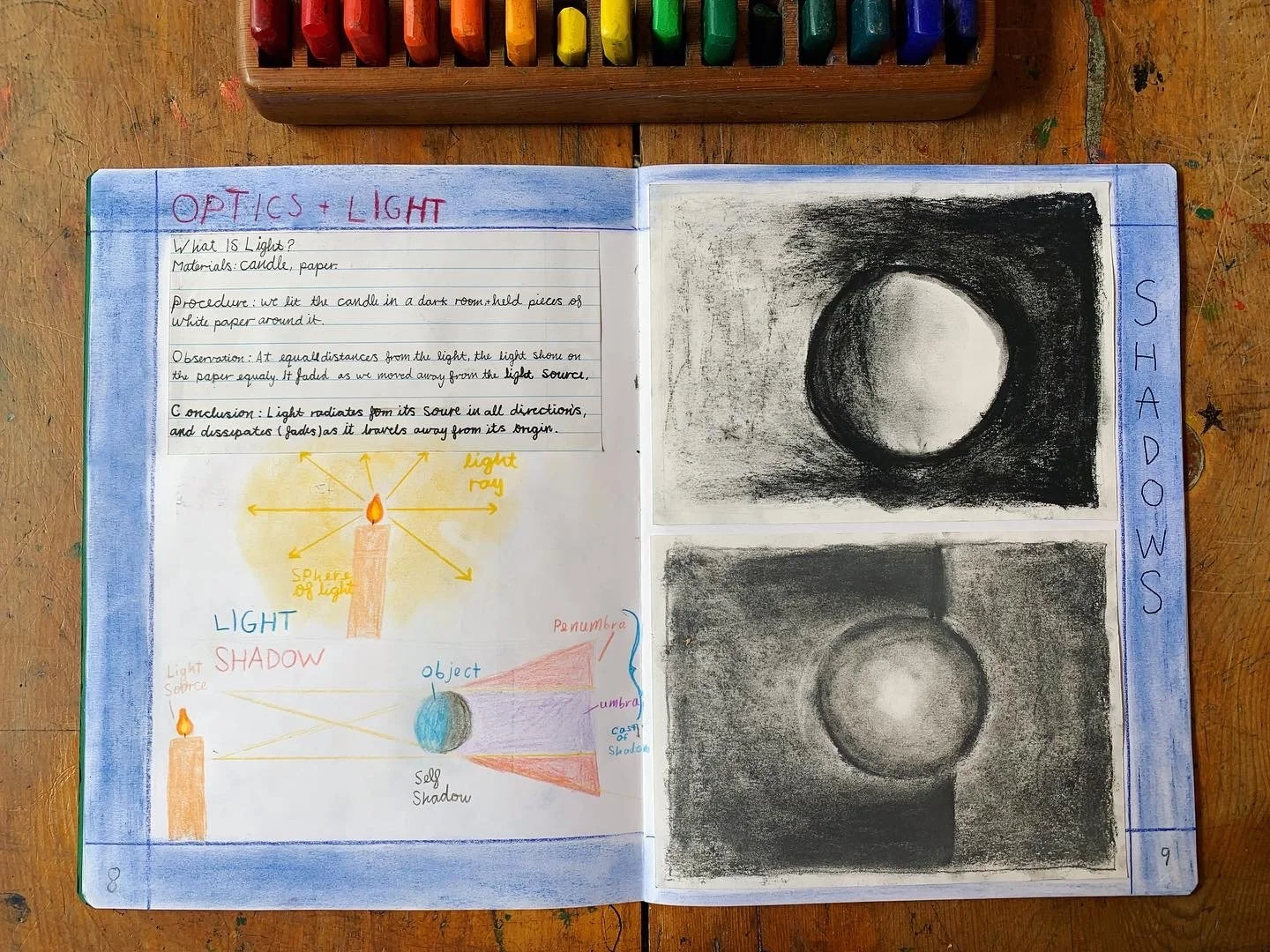
An example main lesson book page from our Seventh Grade Physics course.
Seventh grade physics also deepens the exploration of optics, and begins the study of simple electromagnetism.
In optics, students work with mirrors, lenses, prisms, and the camera obscura to explore reflection, refraction, and how images form. Introductory studies around electromagnetism may include creating simple circuits and building a simple motor, which seamlessly incorporates the study of simple machines.
As with all topics in Waldorf education, the Physics block also provides an opportunity for the educator to weave in biographies of great scientists, and the scientific discoveries of the Renaissance and Age of Exploration. As well, the Physics block offers the perfect opportunity to bring in mathematical topics such as the study of ratios, measurement, and more.
The seventh grade Waldorf physics curriculum provides fresh perspectives and a new way of looking at the world around us, perfect for the seventh grader who is ready for more challenges and creative thinking!





About the Authors
Robyn Beaufoy is Waldorfish’s CEO, and also a course instructor for Simple Season, Waldorf Art for Beginners, and Weekly Art Foundations. You’ll find her intuitive touches and influences throughout everything Waldorfish offers. Robyn has been in the world of education for over 25 years, with an MA in Education and a certification in Waldorf teaching - she also homeschooled both of her children for some of that time. In 2012 Robyn co-founded Waldorfish.com, creating it with the vision of making Waldorf inspired-art and pedagogy more accessible, joyful, and doable for homeschoolers all over the world.
Caitlin Amajor is Waldorfish’s course instructor for Geometry grades 5 & 6, Botany, and Geology as well as our Administrative Assistant. From a young age, Caitlin has been immersed in Waldorf education, attending a Waldorf school from K-8. After receiving a BA in History, Caitlin gained her certification in Waldorf teaching, and is a teacher in the upper grades. With a special fondness for watercolor painting and geometry, Caitlin loves bringing Waldorf education to her students all over the world, and seeing their own individuality and style bloom from the curriculum!

Waldorf Geology: Adapting the Curriculum to Your Region
In Waldorf education, the curriculum really shines when we adapt it to our local regions.

Use your observation skills and senses to explore geology where you live!
This encourages students not only to connect with the material and the greater concepts, but also to deepen their relationship with the land on which they live.
When we teach through the lens of place, we invite students into a living relationship with their surroundings. This is especially true in the Geology block, where children begin to explore how the Earth was formed, how landforms came to be, and how the very ground beneath our feet tells a story about time and transformation.
In the Waldorf Geology curriculum, we explore many facets of the Earth - the formation of rocks, mountains, and valleys; the work of glaciers and volcanoes; and the long arc of change that shapes the landscape. These are big, sometimes abstract ideas. But when we connect them to what’s right outside our door, they become tangible and meaningful.
Pedagogically, this connection is vital. Around ages 10 to 12, children are moving from an imaginative, story-based way of knowing to a more observational, cause-and-effect understanding of the world. Geology meets this developmental moment beautifully: it offers real-world evidence of forces at work, while still appealing to the child’s sense of wonder.
When students can see, touch, and question the rocks in their own landscape, learning becomes personal.
Here are five simple ways to make the Geology curriculum come alive where you live:

Our course creator for Geology grew up in Northern California, and was inspired by nearby Half Dome in Yosemite National Park!
Keep it simple- go outside!
Go on a hike for the day, walk around your neighborhood, and notice the rocks around you. Even landscaping stones, rock walls, or architectural features can become starting points for observation and conversation. Ask: What might this rock have looked like before it was shaped or moved? Where might it have come from?
Go to your local library and explore books about your region.
Even tourist-focused resources may be helpful.
Do some internet research around local mineral, rock or geology clubs.
You may be surprised at how many active groups are nearby!
Go to your town’s local visitor center and explore the history of your town.
See how you can connect the vast world of geology to your region. Remember: Geology is connected to everything! Industrial history, rivers/lakes/water usage, city planning, etc.
Visit a Natural History Museum.
Many museums have geology or rock exhibits that tie local formations into larger geological stories. Seeing specimens up close helps students link their personal observations with the broader scientific picture.

Enjoy exploring the beauty of the natural world, and find geology all around you.
Overall, enjoy weaving the curriculum with where you live, and keep it simple. The act of observing, discussing, and connecting the material to what is around you is one of the most important and valuable activities your student can engage in.
When children experience that the land they live on is part of a great, unfolding story, learning becomes not just academic - it becomes soulful. This is meaningful learning, rooted in place and alive with curiosity.



About the Authors
Robyn Beaufoy is Waldorfish’s CEO, and also a course instructor for Simple Season, Waldorf Art for Beginners, and Weekly Art Foundations. You’ll find her intuitive touches and influences throughout everything Waldorfish offers. Robyn has been in the world of education for over 25 years, with an MA in Education and a certification in Waldorf teaching - she also homeschooled both of her children for some of that time. In 2012 Robyn co-founded Waldorfish.com, creating it with the vision of making Waldorf inspired-art and pedagogy more accessible, joyful, and doable for homeschoolers all over the world.
Caitlin Amajor is Waldorfish’s course instructor for Geometry grades 5 & 6, Botany, and Geology as well as our Administrative Assistant. From a young age, Caitlin has been immersed in Waldorf education, attending a Waldorf school from K-8. After receiving a BA in History, Caitlin gained her certification in Waldorf teaching, and spent seven years as a Waldorf class teacher in the upper grades. With a special fondness for watercolor painting and geometry, Caitlin loves bringing Waldorf education to her students all over the world, and seeing their own individuality and style bloom from the curriculum!

Nature Journaling in Fifth Grade: More Than Just a Drawing Lesson

In Waldorf Education, science is taught by doing and observing!
In Waldorf education, fifth grade marks a special shift - one where science becomes more focused, more intentional.
Beginning with Botany in the fifth grade and progressing to Physics, Chemistry, Geology, Anatomy, and more in the later years, students are invited into the world of science not through textbooks or lectures, but through phenomenology—an approach that begins with observation and lived experience.
In practical terms, this means students are encouraged to experience scientific phenomena directly, often through demonstrations or hands-on activities, and then draw their own conclusions. No memorizing facts just to regurgitate them—this is science experienced through the senses.
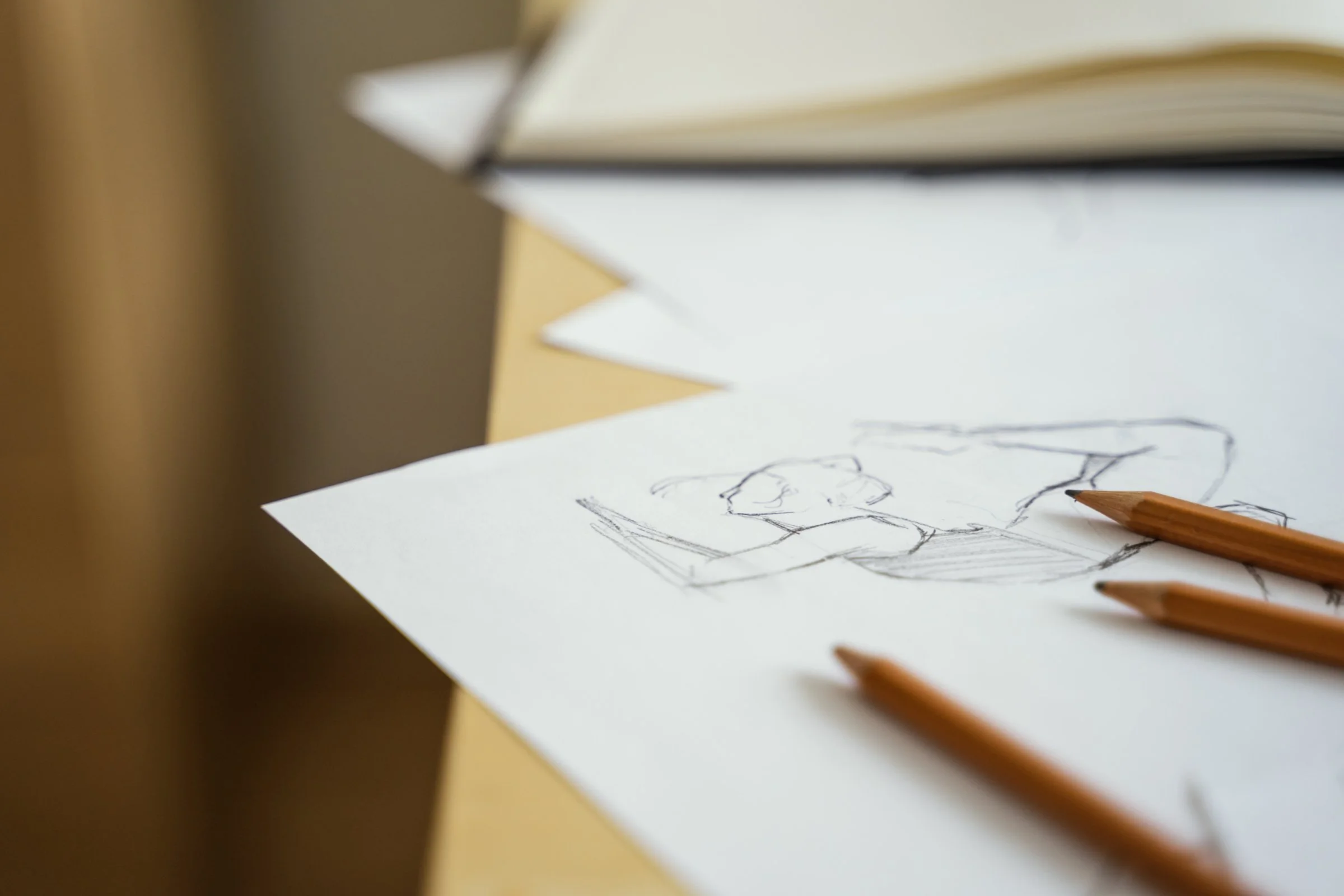
One of the most beloved activities in the fifth-grade Botany block is something called Nature Sketching (sometimes also called Nature Journaling). It’s simple on the surface: students take their colored pencils, etc. and sketchbooks outdoors, find one subject that captures their attention - a flower, a leaf, even a curled root peeking out of the earth - and spend time carefully observing and drawing it.
But here’s the thing: it’s not about the drawing. Not really.

Nature sketching provides a moment of quiet in a busy, fast world.
Sure, students are encouraged to draw what they see with care - matching color, texture, shape, position - but the true goal is deeper. We’re helping them learn to slow down, to really look, and to begin noticing the small details that might otherwise go unseen.
What does the flower smell like? What’s its texture? How many petals? What’s the light doing at that time of day?
This moment of quiet, focused attention is a rare gift in our fast-paced world. And it turns out, it’s doing more than just building observation skills. Nature journaling also introduces two incredibly important ways of thinking that scientists and artists alike rely on: distributed cognition and metacognition.
Let’s unpack those.
Distributed cognition is a fancy way of saying: sometimes, our brains need a little help keeping track of everything. That’s why we use things like calendars, grocery lists, or calculators - they’re all tools that “share the load” of thinking. In the same way, a nature journal becomes a thinking partner. Instead of trying to remember every detail of a flower or the texture of a leaf, the student writes it down or draws it. Their journal becomes an extension of their memory and attention - just like a scientist’s field notebook.
And then there’s metacognition - thinking about our thinking. As John Muir Laws puts it, “Thinking about our thinking helps us think better.” When students go back and review their nature sketches and notes, they’re not just remembering what they saw; they’re also reflecting on how they observed, what they were curious about, and how their perspective might have changed. That’s metacognition in action - and it’s a powerful habit to develop.
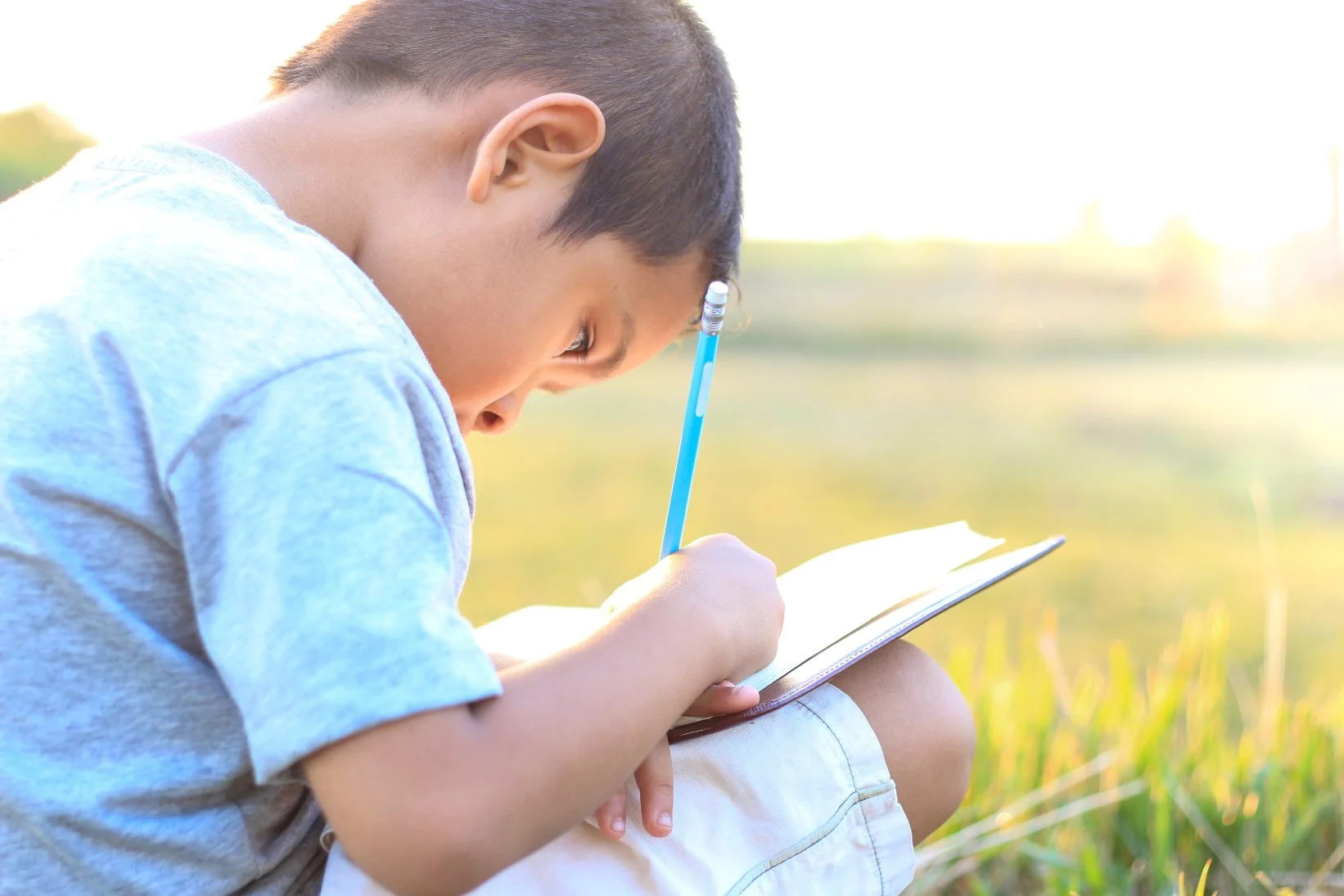
Nature sketching is a multi-faceted, powerful tool.
What’s more, the simple act of nature sketching engages a whole web of skills: fine motor skills, attention to detail, language arts (through labeling, note-taking, or journaling), even basic quantitative skills like counting, measuring, and comparing. And every time a student tries something new - maybe they’ve never blended colored pencils to show shading before, or never really paid attention to the shape of a leaf - their brain is making new connections. That’s neuroplasticity at work: the brain growing and adapting through experience.
So while it may look like just a quiet moment with paper and pencil out in the garden or forest, Nature Journaling is a deceptively powerful tool - one that builds scientific thinking, strengthens artistic observation, supports language and reflection, and even grows the brain itself!
And best of all? It invites the student into a lifelong relationship with the natural world - one quiet sketch at a time. And what our students learn to love, they will strive to protect.
More from Waldorfish:





About the Authors
Robyn Beaufoy is Waldorfish’s CEO, and also a course instructor for Simple Season, Waldorf Art for Beginners, and Weekly Art Foundations. You’ll find her intuitive touches and influences throughout everything Waldorfish offers. Robyn has been in the world of education for over 25 years, with an MA in Education and a certification in Waldorf teaching - she also homeschooled both of her children for some of that time. In 2012 Robyn co-founded Waldorfish.com, creating it with the vision of making Waldorf inspired-art and pedagogy more accessible, joyful, and doable for homeschoolers all over the world.
Caitlin Amajor is Waldorfish’s course instructor for Geometry grades 5 & 6, Botany, and Geology, as well as our Administrative Assistant. From a young age, Caitlin has been immersed in Waldorf education, attending a Waldorf school from K-8. After receiving a BA in History, Caitlin gained her certification in Waldorf teaching, and spent seven years as a Waldorf class teacher in the upper grades. With a special fondness for watercolor painting and geometry, Caitlin loves bringing Waldorf education to her students all over the world, and seeing their own individuality and style bloom from the curriculum!
Looking for something?
Welcome to Waldorfish! We started this adventure in 2012 out of a desire to make Waldorf training more accessible to class teachers in remote locations and to homeschooling families everywhere! Read more, click here.


WE WON! Our Weekly Art courses were voted “best interactive art program.” Learn more about the award, here.


Click here for a full list of schools we work with.
A few of our most popular blog posts:

Who are our courses for?

Starting Waldorf First Grade
4 Things to Know Before Planning Your Homeschool Year

In Praise of Balance: A Healthy Festival Life
Science in Waldorf Middle School: Starting Something New!