
Waldorfish Blog

The Waldorf Geology Block: Curriculum for the Transforming Child
An exciting aspect of the sixth grade Waldorf curriculum is a new area of study: Geology!
Of course, students have been studying the earth since the beginning of their academic journeys: agriculture in third grade, gardening class, and more!
This block is sometimes given the title “Mineralogy,” which we are intentionally choosing not to use here. Mineralogy is it’s own vast subject under the umbrella of Geology - one that requires an understanding of general geologic concepts. In sixth grade, the curriculum touches upon the formation of different minerals, but the goal is to really live into Geology and all the basic concepts that lead into more complex studies in the future.

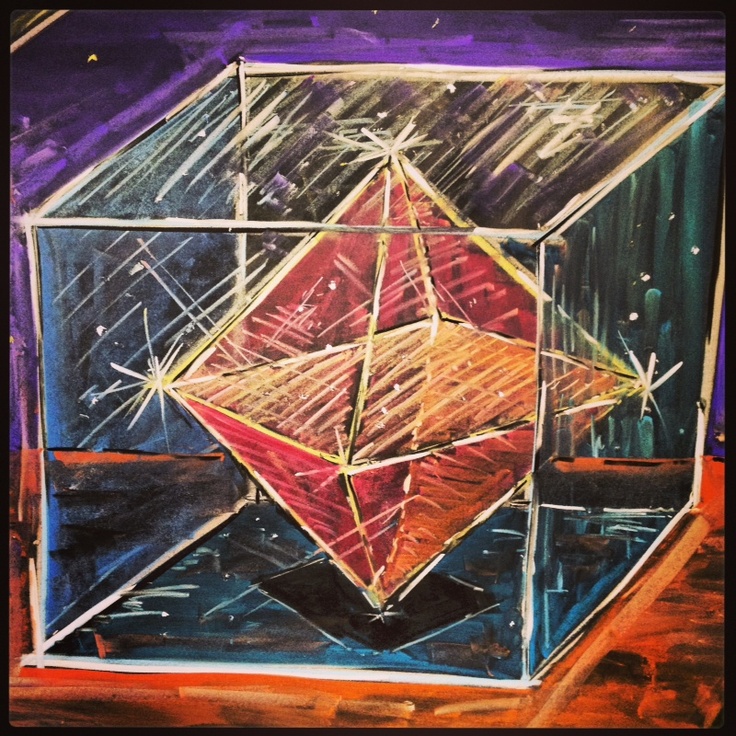
Chalk is a wonderful medium to use in a geology block- it provides color, texture, and dimension!
The curriculum of the whole sixth grade year marks an important shift in the approach to learning, and it’s the perfect time to dive into geology, which means “the study of the earth.”
The sixth grader is beginning the very powerful journey of puberty; a deeply inward experience where their emotions, physical body, relationships, and worldview, all undergo a transformation. Some of these changes are quick and visible, others can be slow burning and invisible to those around them. Emotions can be hot and fiery one day - cold and aloof the next! While some days a sixth grade child may feel like the world is vast, open, and full of potential, just as quickly, it can feel small, closed, and pressure-filled. Physically, the student might feel light, airy, and free… and in the next moment they can just as easily feel heavy, awkward, and slow moving.

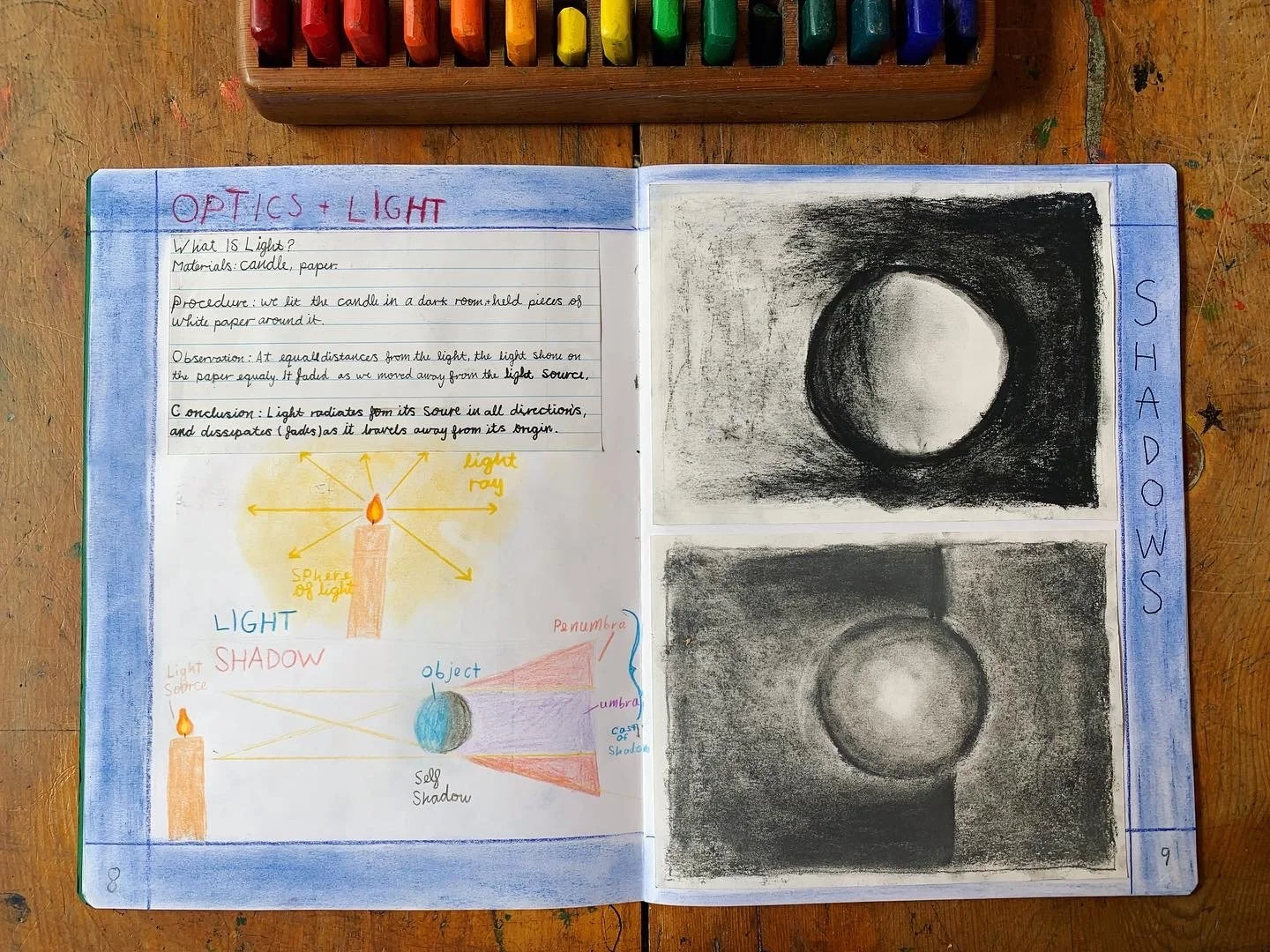
Charcoal is a new art medium to the sixth grade curriculum, and can be used throughout the school year- even in geology!
The growing student is experiencing polarities in a very real way- enter in the study of Geology as the perfect mirror!The geology curriculum is designed to meet students just where they are on their journey of conflicting feelings, emotions, and experiences.
Geology is full of great clashes and yet also contains seemingly insignificant subtleties. A volcano can erupt in a dramatic blast of lava and smoke, while sedimentary rock forms slowly under consistent, unseen pressure over millions of years. A mountain slowly grows taller through the process of uplift, or a new underwater trench may suddenly open from a powerful earthquake. Geology is ever moving, ever changing, and through processes that slowly unfold over time, or suddenly flare up without warning. On a deeply personal, soul level, the student connects with the earth and finds a sense of place and comfort- while they undergo great transformation, so too has the earth on which they stand!
Geology challenges the student to think big and small at the same time. They are looking at the earth in a new, far more abstract way than ever before.
Now the educator asks the student to use different thinking skills. What is the earth really made of, down to its core? What does the presence of exposed granite tell us about what may have existed here millions of years ago? What could an earthquake in the present do to the landscape of the future? Let’s think beyond just what we can see and what surrounds us- it’s time to explore the past, the present, and the future!

This is an example of a wet-on-dry painting: watercolor paints used on dry paper.
As well, the study of geology provides a deeply meaningful way to build one’s connection with the four elements and with nature. The experience of being a teenager and puberty can be one that brings forth real loneliness and feelings of separateness. A growing child may be unsure of where they belong, who they are connected to, and where they fit in socially and emotionally. In geology, the educator can foster a sense of belonging. The four elements, earth, water, air and fire, are found within every human being just as they are in geology.
The sixth grader is in a very important and often poignant point in their development, where so much is happening for them on and beneath the surface. The geology curriculum is designed to meet them right where they are. Just like the earth, the student is in a continuous and often intense point of transformation – and whether these changes are dramatic or subtle, they matter!
As with all things in Waldorf education, diving into a curriculum that truly meets the child is a deeply meaningful way to build the students’ knowledge, connection to nature, and relationships with themselves and others.



About the Authors
Robyn Beaufoy is Waldorfish’s CEO, and also a course instructor for Simple Season (coming soon!), Waldorf Art for Beginners, and Weekly Art Foundations. You’ll find her intuitive touches and influences throughout everything Waldorfish offers. Robyn has been in the world of education for over 25 years, with an MA in Education and a certification in Waldorf teaching - she also homeschooled both of her children for some of that time. In 2012 Robyn co-founded Waldorfish.com, creating it with the vision of making Waldorf inspired-art and pedagogy more accessible, joyful, and doable for homeschoolers all over the world.
Caitlin Amajor is Waldorfish’s course instructor for Geometry grades 5 & 6, and Botany, as well as our Administrative Assistant. From a young age, Caitlin has been immersed in Waldorf education, attending a Waldorf school from K-8. After receiving a BA in History, Caitlin gained her certification in Waldorf teaching, and spent seven years as a Waldorf class teacher in the upper grades. With a special fondness for watercolor painting and geometry, Caitlin loves bringing Waldorf education to her students all over the world, and seeing their own individuality and style bloom from the curriculum!

Waldorf Geometry: How it Meets the Sixth Grader
A running theme of the sixth grade Waldorf curriculum is the phrase “cause and effect.”

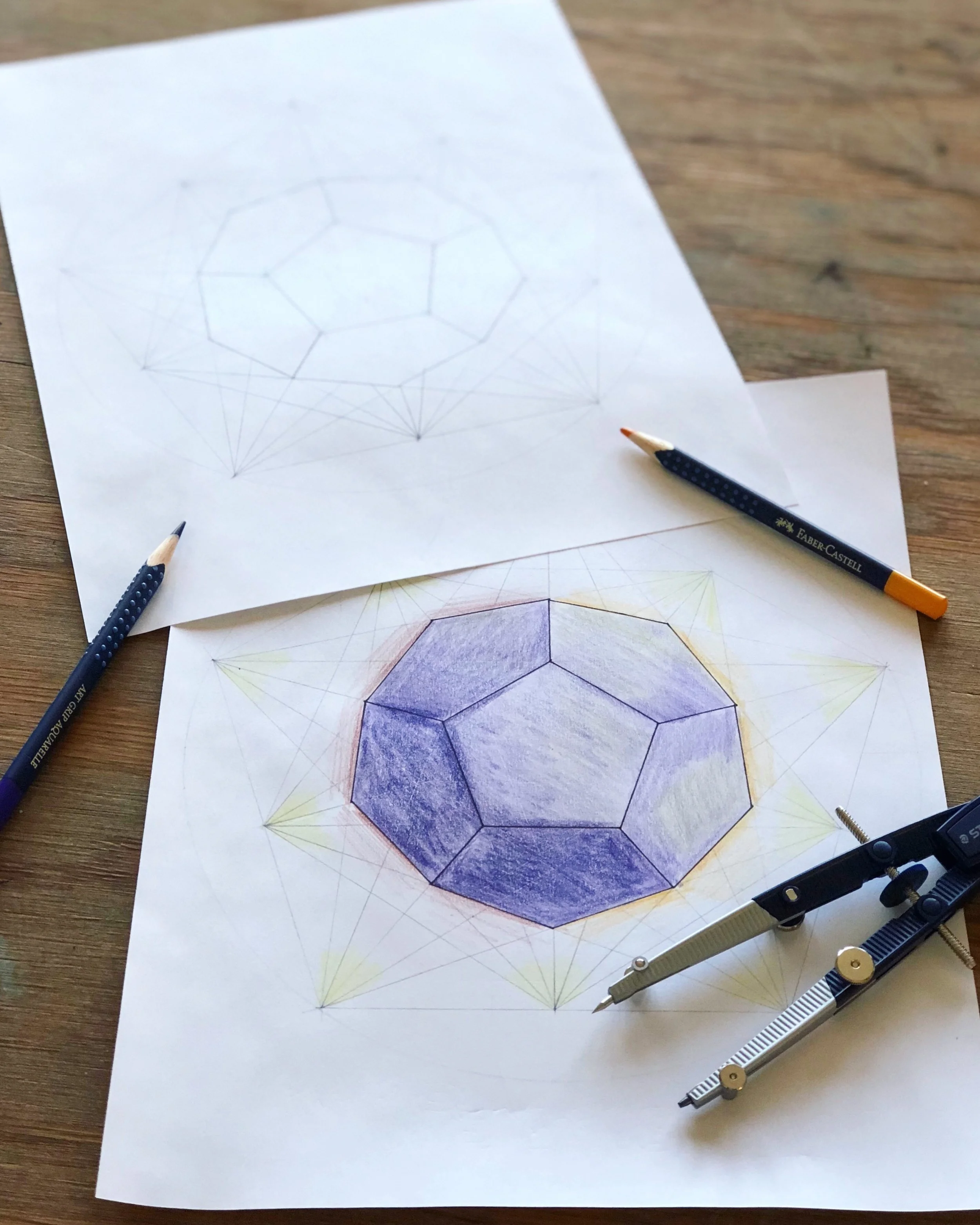
A twelve pointed circle becomes something beautiful with some color and shading!
Students at this age are ready to experience and observe more on their own than ever before, which is why we introduce the formal study of science, history, and more (and if you’re interested in learning more about the middle grades science, click here!)
My favorite subject to teach in sixth grade is geometry (not a big surprise to you, I’m sure!) It’s a block I look forward to, and deeply love, and not just because it speaks to me personally, but because I truly enjoy watching the transformation the materials create space for within the young middle schoolers.
The students have experienced geometry in fifth grade, so the subject isn’t completely new to them. They are familiar with the vocabulary, and have discovered and experienced the balance, symmetry, and beauty that freehand geometry provides.
In sixth grade, the geometry block brings a new experience for the student, and it's one that doesn’t always get the credit it deserves! But in my experience, it is perhaps the most important and developmentally appropriate block of sixth grade: it is all about cause and effect, the beauty of order, and the laws of nature.
So, how does the geometry curriculum reinforce the sixth grade theme of “cause and effect”?
If we’re constructing a six pointed form, the compass point must lay on the intended point as perfectly as possible. If it’s a little off, then the whole form will be a little unbalanced.
If we are constructing parallel lines and don’t use our straightedge accurately, then we simply won’t end up with parallel lines when we are done.
If we construct six equidistant points on a circle’s circumference, and connect them one by one with straight lines, then we’ll create a hexagon.
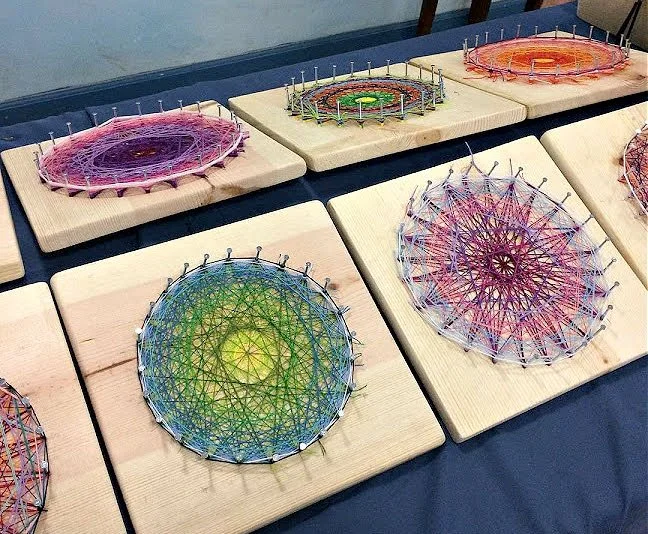
We include a string form lesson in our sixth grade geometry course!
Notice the “if….then…” wording?
If this, then that.
Rule, order, and natural consequences that exist without opinion or judgement- kind of perfect for a sixth grader, who probably feels judged often, unsure of where they stand in the world, and feels change all around them and in their physical body.
Truly feeling the reality of cause and effect, as well as the challenges and satisfaction that come with the experience of using tools and constructing complex forms, is deeply important for the student.
So what then is the significance of the next step, which is shading and using color to finish the final form?
This second step of using color and shading techniques, is a critical piece for the student to experience to truly get the benefits that this block provides. Now is the time to give them choice - what colors will they use? Bright, soft, bold, dark? Will the form be darker on the outer edges and get lighter as it moves in?
The choices are endless. When my students came to the point that a final form was ready to be finished with color, it never failed that the room would become quieter, students would arrange their pencils in possible color combinations, and careful, intentional work would begin. Beauty would begin to bloom around the classroom!

Student work displayed from a sixth grade classroom- every form and drawing is unique and beautiful!
Within the laws of nature, there is space for the beauty of the individual.
Isn’t that amazing, and so important for an-almost-teenager to experience?
For a sixth grader (or perhaps everyone?) it is important to hear and experience the comfort and structure that comes with knowing the laws of nature. We can count on these truths, and know that they will not waver, no matter how chaotic the world may seem. And within these laws, there is space for one to create beauty, and express their individuality in important and impactful ways.
I know these are big and lofty things to say about just one 3 or 4 week block, but I don’t say them lightly!
Geometry really is that powerful, meaningful, and just plain amazing.
Bring your homeschool curriculum to the place where art meets math! Our courses for grades 5-8 provide a full year’s worth of curriculum, instructor support, step-by-step instructions, and so much more.

About the Author
Caitlin Amajor taught in the Waldorf middle school for seven years, and was also a Waldorf student herself! She currently works as an administrative assistant for Waldorfish, and is also the instructor for the grades 5 and 6 geometry courses. Caitlin enjoys baking, gardening, and spending time with friends and family.

Perspective Drawing - Art in the middle grades
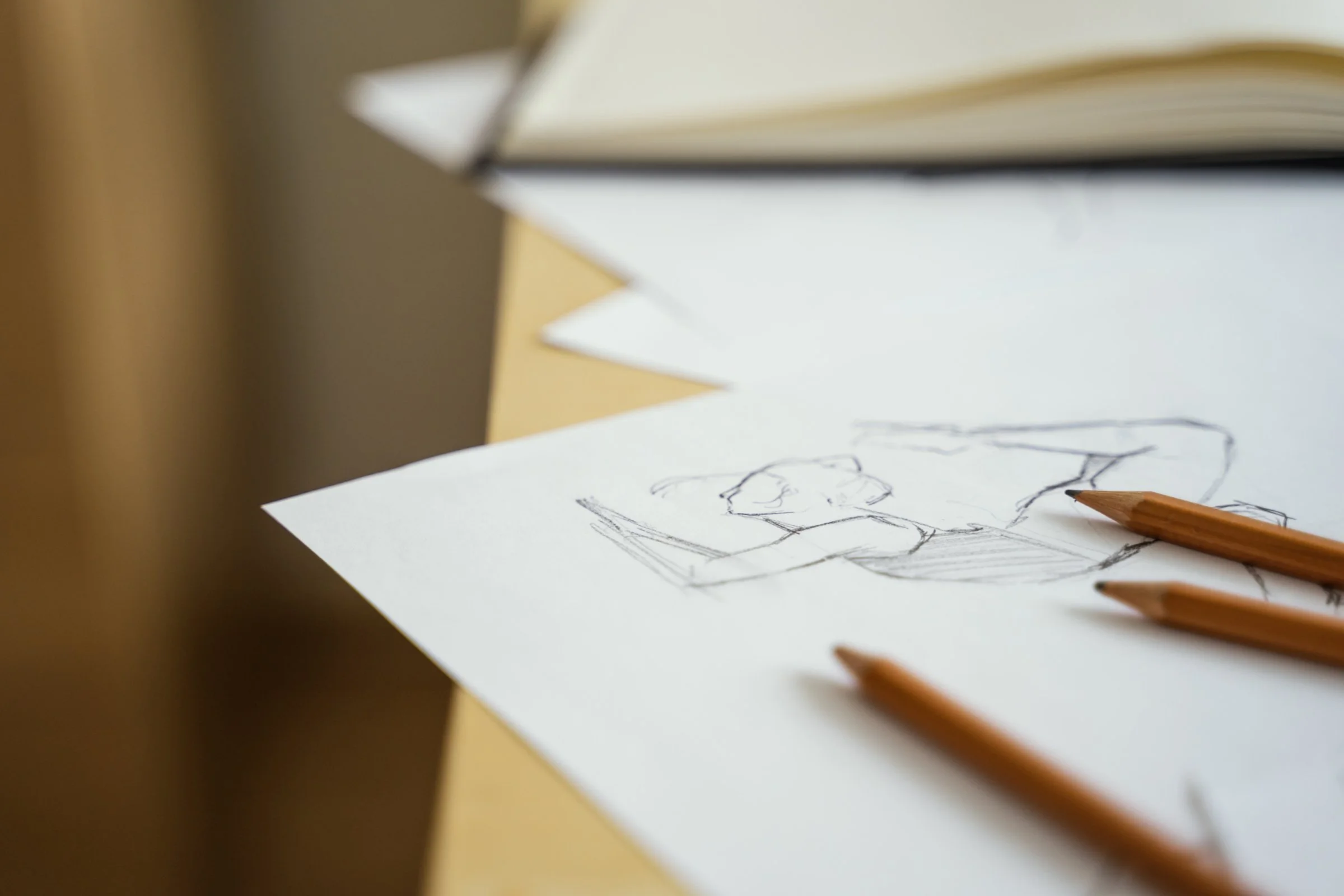
Teaching perspective drawing to seventh graders has always been a highlight for me.
This is one of those magical moments where the curriculum meets the students everywhere they need to be met.
Thirteen year olds are always right.
Just ask them ;)
A seventh grader is desperately trying to form his or her own point of view and beginning to understand that we all see the world through our own, unique lens. The most important concept of perspective drawing is the establishment of point of view. In perspective drawing, the artist must constantly ask "how would this look from my perspective?"
(Looking for guided support teaching this subject? Our course, Weekly Art Diving Deeper includes a series of step-by-step Perspective Drawing Lessons!)
The Horizon Line
The horizon represents the limit to how far the eye can see, assuming we can look beyond the buildings, trees, and mountains that might be in the way. In perspective drawing, the horizon is a straight line that establishes the "eye line" or point of view of the artist. In reality, we know that the horizon is not straight because the earth is round. We draw it as a straight line because that's how we perceive it. (More on perception versus reality later)
It's fitting that a seventh grader should grapple with the idea of learning to understand the world between him/and the flat horizon which, in turn, begs the questions: "What's beyond the horizon? and... Isn't the world round?"
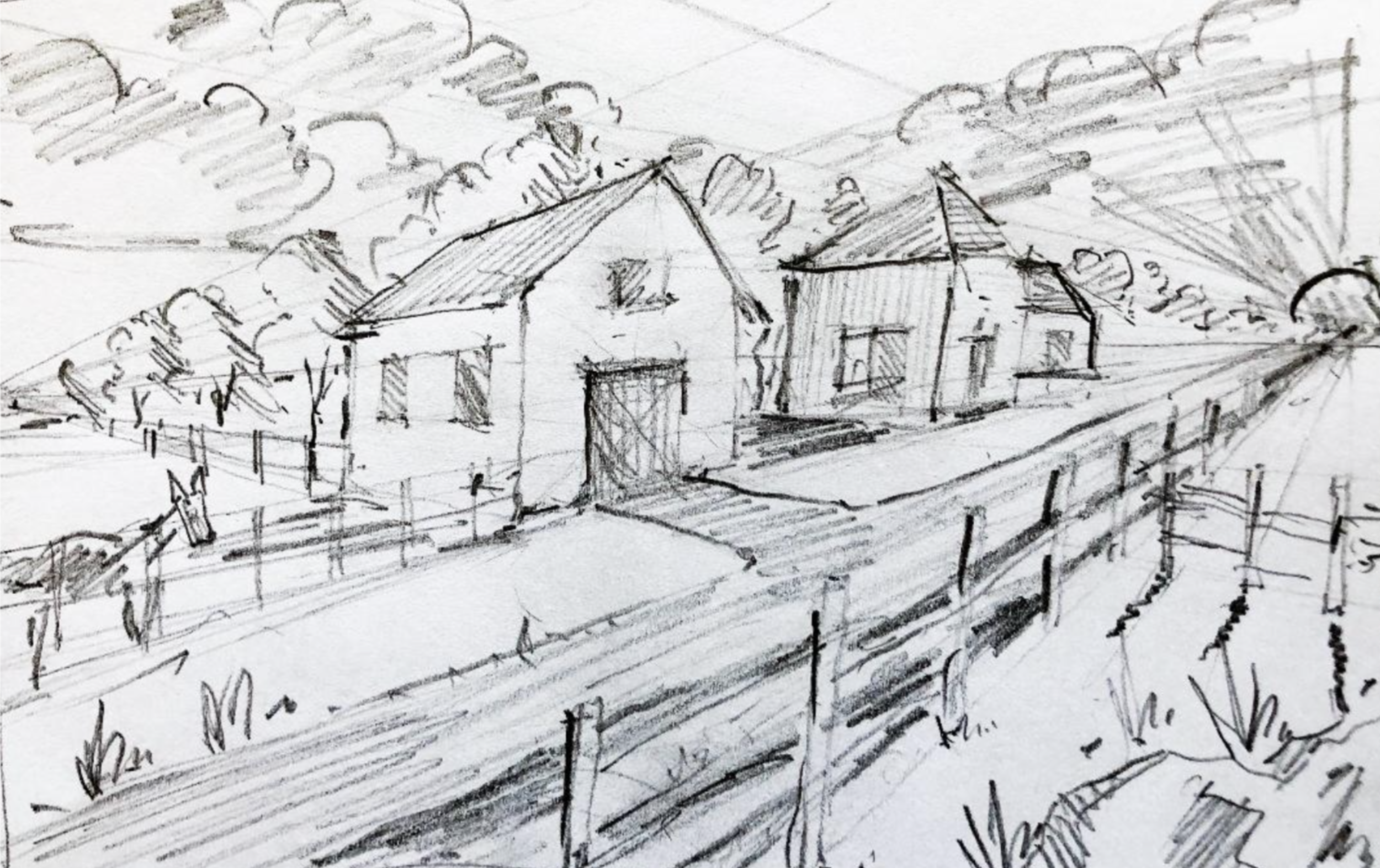
Depth, distance, and creating from a certain point of view: this is perspective drawing!
Vanishing Points
In the sixth grade, students are often satisfied with isometric three dimensional drawing. All of the lines of an isometric box are parallel. It looks real! Life gets a little more complicated in 7th grade, however, as the students move farther away from the simplicity of childhood. The typical seventh grader begins to question everything (especially the teacher!).
When it comes to teaching perspective drawing, I like to teach by asking questions. "If the sides of this cardboard box are equal in length and parallel in real life, why do they look like they're getting closer together as they go off into the distance?" Soon they discover that straight lines going into the distance appear to line up with vanishing points on the horizon. Now they are ready to construct rules for drawing the world as it appears to us.
On more subconscious level, there is another phenomenon at play. As human beings, we can venture beyond the horizon in the physical world, and we can explore the depths of our inner selves. The vanishing point on the horizon mirrors the vanishing point inside each human being. Interestingly, both the horizon and the vanishing points are not fixed.
They are simply boundaries placed by the artist based on his or her unique perspective at a single moment in time.
Art as metaphor for life.
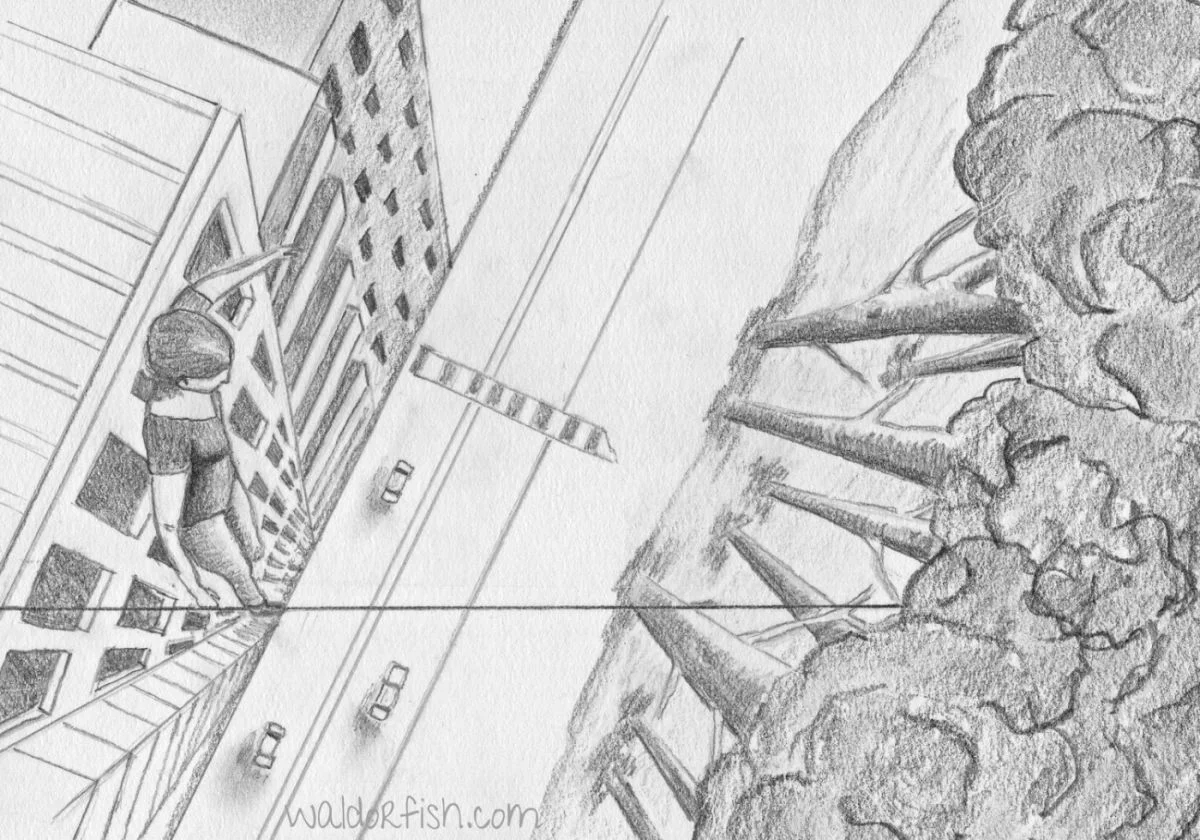
Why not try drawing from a different point of view?
Perception vs. reality
I love taking seventh graders through this journey of building a set of rules to create reality and then realizing that we need to keep bending the rules when a new piece of information is introduced.
"Why does it seem like there's more than one vanishing point?"
"Why does it seem like all the vanishing points change in reality when I move my eyes?"
"Is there really a point out there?"
Some students are happy to live inside the set of rules for perspective drawing and some edge closer to the idea that this set of rules is a convention that humans created. It's a method of taking our visual perception of the three dimensional world and putting it onto a two dimensional surface in a way that accurately represents the artists point of view at that particular moment in time.
The process is akin to learning a language in order to express your point of view. It's all the more valuable if our students can be guided towards developing this set of rules on their own. As they work with the drawing exercises, I encourage you to try not to give in to the temptation of TELLING them what they are experiencing. The questions that lead to the rules will naturally flow out of them if they are given many opportunities to EXPERIENCE the drawings!
—> Download Brian’s teaching notes, from his Perspective Drawing course for teachers at Rudolf Steiner College:
Content related to the middle grades:




Waldorf Geometry :: Math in the middle grades
Ge•om•e•try | noun
Origin:
Middle English- via Old French from Latin “geometria”, from Greek, gē ‘earth’+ metria ‘measurement’.
Earth Measurement. This sounds like something entirely different from most of our own experiences with Geometry in school, yes?
Over thousands of years, geometry has become a standard part of math class and yet it sits in the modern math curriculum isolated from its true origin.
Ancient scholars, the first geometers, understood geometry to be the act of measuring the complete human experience of living on Earth. They set out on this study in order to understand the design behind everything they were experiencing in the physical world. In ancient Greece, the latin word “Mathematikos” meant “desire to learn” and the latin word “mathema” meant “knowledge/study.” In other words, the measurement and study of the physical world in order to understand the human experience on earth and how everything around us is created.
“Inspiration is needed in Geometry, just as much as in poetry.”
Rudolf Steiner and Waldorf education place the utmost importance on Geometry in the Waldorf curriculum, and have created a different path for students than the typical math curriculum offers.
In truth, in Waldorf schools children begin their study of “earth measurement” with their first lesson on the first day of first grade - by drawing straight lines and curved lines. Straight lines and curved lines are nature’s design tools and they will become the essential building blocks of writing and drawing.
Printing, cursive, numbers, and music notation are constructed with lines and arcs. As the students progress through the early grades, patterns of lines and arcs are part of almost every lesson. Where there are patterns, there is geometry. Clapping games establish rhythm and order. Eurythmy and dance involve expression by way of patterns in movement. Students sit in rows, circle up, and line up.

Waldorf geometry curriculum evolves as the child grows through grades 5-8!
Music and geometry go hand in hand as well. Rhythm, intervals, and patterns are the geometric design of music and poetry. As the students learn more about music, they can observe how different geometric patterns in music have unique qualities that induce a particular mood or feeling. Major chords sound “happy” and minor chords sound “sad.” The interval between a root note and the 5th sounds and feels much different than the interval between the root note and the seventh. Music is a great example of geometry as the tool behind the expression through sound. The idea of math as a universal language actually goes much deeper than numbers and calculations on paper being the same everywhere in the world. Ideally, a child’s education in the early grades is full of geometry.
Early experiences with Waldorf Geometry
In grades one through four, there is no formal geometry class. Geometry comes by way of everyday school life (music, writing, movement, etc) and Form Drawing class. Forms are patterns of straight and curved lines that become more complex as the children advance through the grades. Simple repeating forms in grades one and two help with the development of coordination for printing and cursive writing. More complex forms in grades three and four help to develop a sense of spatial awareness and symmetry. In the fourth grade, students practice forms that are also symbols from different cultures (i.e. Nordic symbols) and learn how to tie knots - a three dimensional version of the form drawings.
Try A Free Geometry Lesson
Moving into the middle grades
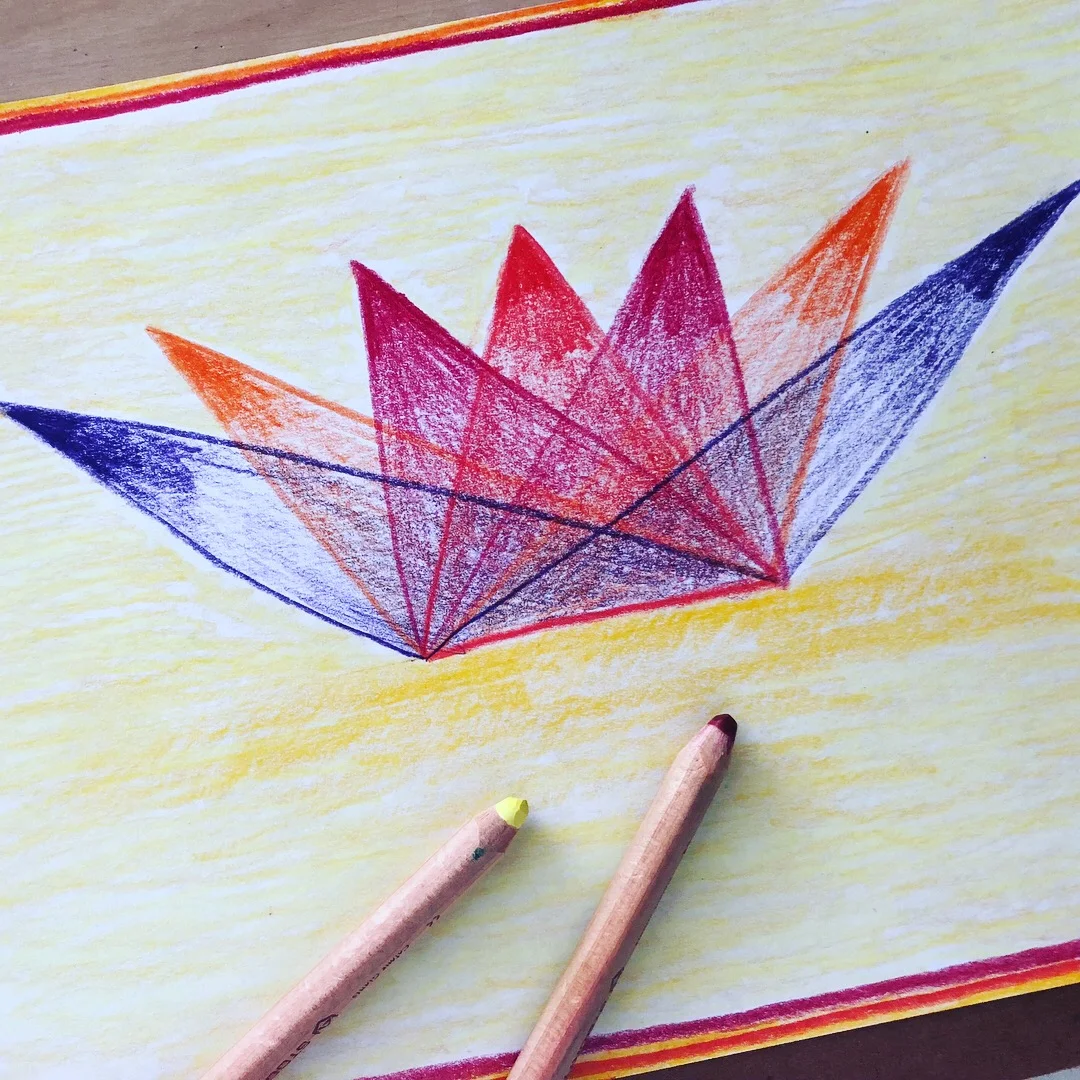
An example of a fifth grade freehand form with colored pencil.
Grade Five - Freehand Waldorf Geometry
Grade five is a special, transitional year, symbolic of the peek of childhood. The students study great civilizations of the past, including the “Golden Age” of Greece. The students themselves are in the golden age of childhood.
They are at the peak of their development in their child bodies and have gained as much mastery of their physical bodies as they are going to before heading into puberty. Fifth grade also marks the transition from form drawing to geometry. The goal of grade five “freehand geometry” is to lock the archetypal geometric forms into the body by drawing them without the use of tools. Classes also set out to find geometric forms in the world outside of their classrooms.
(Learn more about fifth grade geometry here!)

This form begins with twelve points on a circle- all constructed with a compass and straightedge!
Grade Six - Geometric drawing tools
With the arrival of adolescence, grade six becomes a year of re-birth both physically and in the curriculum. In geometry, we need to go all the way back to the beginning with straight lines and curved lines. This time, however, the children learn to construct lines and arcs with geometric drawing tools. A straightedge (ruler) constructs a line and a compass constructs an arc. The students will now begin a second journey through geometry that mirrors grades 1-5. The three-fold approach to learning (doing, feeling, thinking) is beautifully displayed in the geometry curriculum. In grade 6, the focus is on the physical doing aspect of learning. Learning to use tools to construct and measure is a physical task and it challenges the students as they begin to develop new physical bodies. The focus on “doing” in grade six mirrors the 1st and 2nd grade curriculum where an understanding of lines, arcs, and patterns comes from drawing forms with both the hands and feet, walking patterns, and rhythmic clapping games, etc.
(Learn more about sixth grade geometry here!)

Seventh grade geometry curriculum weaves into history, art, mathematics, human anatomy, and more!
Grade Seven - Inward and outward exploration
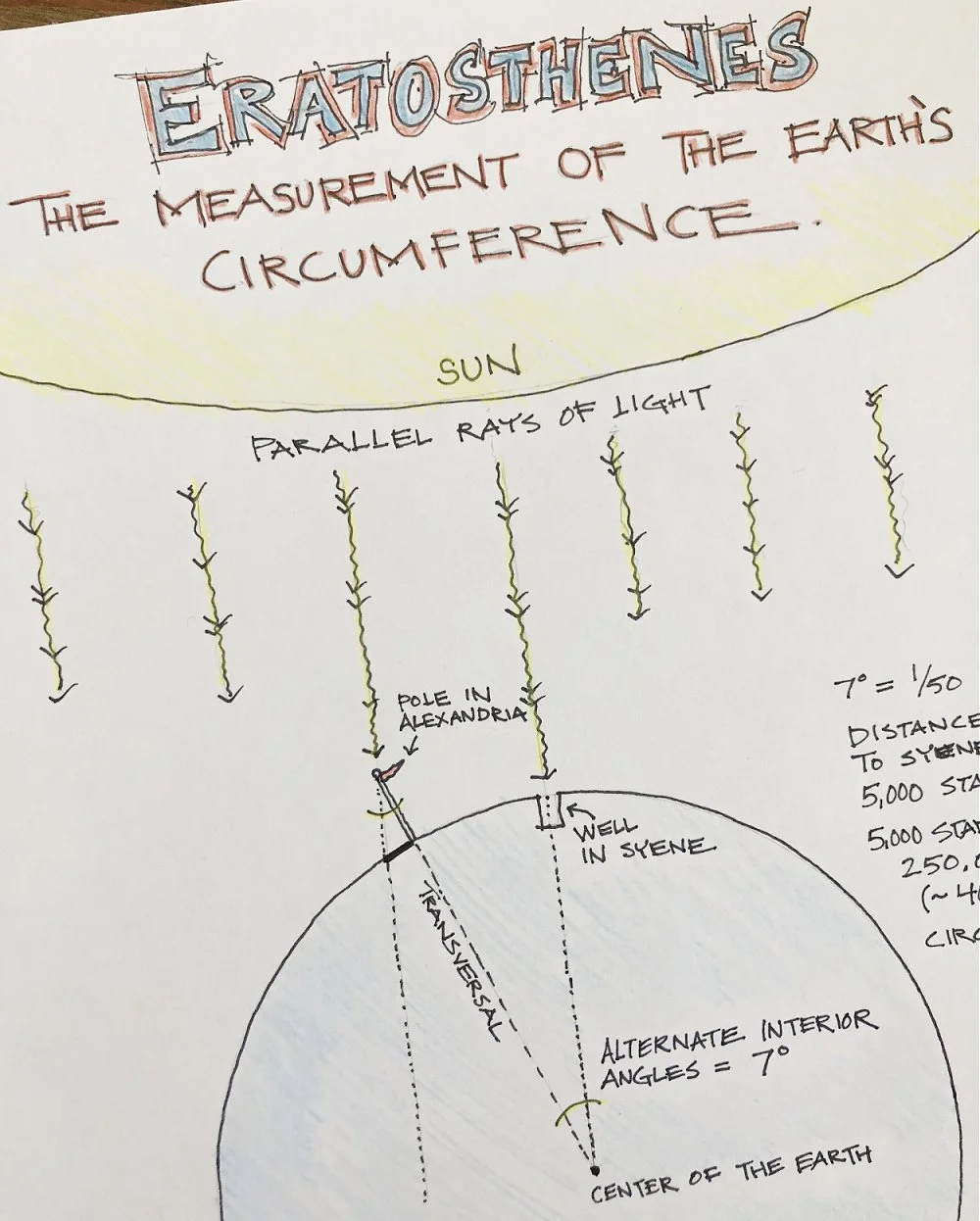
Grade Seven in Waldorf schools is generally thought of as “the year of exploration.” A seventh grader, now fully immersed in adolescence, is ready to outwardly explore the physical world and inwardly begin an exploration of the question “who am I?” The feeling life of the seventh grader takes center stage in the curriculum as we use geometry to understand the human body and the natural world we live in. Da Vinci’s Vitruvian Man and the work of Fibonacci give us clues about the mathematical formula behind all that is living on our planet. It’s an incredible moment when students discover that the same ratios and patterns found in pentagrams, roses, apples, insects, hurricanes, and the milky way galaxy, are also found in the structure of our own bodies. The observational studies of nature performed by the likes of Plato, Pythagoras, Eratosthenes, Fibonacci, and Leonardo Da Vinci are mirrored by the observational powers of the seventh grader (they see everything, yes?).
Grade Eight - Digging deeper
In grade eight, the geometry curriculum enters the thinking realm. Armed with knowledge about how to use the tools of the geometer and the experience of searching for one’s self both in nature and the human body, the students are ready to become mathematicians, in the ancient Greek spirit of the mathematician being one who studies all things.

Eighth grade geometry works with 3D forms- both on paper and with hands-on modeling!
We can now venture into the world of abstract thought and theory. The students will grapple with how to measure and study the three dimensional world on the two dimensional surface of the paper. By the 8th grade, it is the hope that students can see that there is always more than meets the eye, and they now have the physical and intellectual tools to dig deeper through observation, making precise measurements and calculations, and articulately describing what they see. They are mathematicians, scientists, and philosophers training to see things on multiple levels.
On one level, numbers define quantities and help us with measurements and calculations. On another level, each number has its own unique set of qualities. Like the circle, the number one represents wholeness and the beginning. Plato called the circle “the mother of all shapes.” When the whole is cut into two, polarities are created (up, down, left, right, life, death, hot cold, positive, negative, male, female, etc.). The number three has a very balanced quality (tripods, tricycles, triangles). This way of understanding the quality of numbers is similar to the phenomenological way of teaching science. When a botany student imagines a plant, the goal of the teacher is to get the child to have a fluid mental picture that includes the entire life cycle of the plant, as opposed to just a fixed image of the plant in a particular moment in time.
With geometry, the goal for the 8th grader is to help them think of numbers not just as quantities but as parts of patterns in nature with their own qualities that shape the world around us and our experience of the world.
“Let no one ignorant of geometry come under this roof.”
•We created a 3 page Qualities of Numbers reference guide for you! Tell us where to send yours in the form below. It’s free!
•We offer a comprehensive Geometry curriculum, covering the grades 5-8.
Related content:


Looking for something?
Welcome to Waldorfish! We started this adventure in 2012 out of a desire to make Waldorf training more accessible to class teachers in remote locations and to homeschooling families everywhere! Read more, click here.


WE WON! Our Weekly Art courses were voted “best interactive art program.” Learn more about the award, here.


Click here for a full list of schools we work with.
A few of our most popular blog posts:

Who are our courses for?

Starting Waldorf First Grade
4 Things to Know Before Planning Your Homeschool Year

In Praise of Balance: A Healthy Festival Life
Science in Waldorf Middle School: Starting Something New!