
Waldorfish Blog

Waldorf Art: How is Art Incorporated into the Waldorf Middle Grades, 5-8?
Q: How is art incorporated into the Waldorf middle grades, 5 through 8?
(This post is part of a series in which we answer the most common questions we receive in our inbox re: homeschooling, Waldorf curriculum/pedagogy, and whatever else comes our way! Click here to read more from the series!)
A: Art is woven into every aspect of the Waldorf upper grades curriculum, no matter the subject!
(And just so we’re all on the same page, we’re using ‘middle grades’ and ‘upper grades’ interchangeably to refer to the grades 5-8.)
Whether in history, science, or math, the upper grades student is continuously learning through artistic skills and expression.
It is common in today’s world to think of art as its own stand-alone subject; many students experience “art class” where there is a specific time in a student’s school day for art, and otherwise, they are focusing on non-art subjects like math or science.
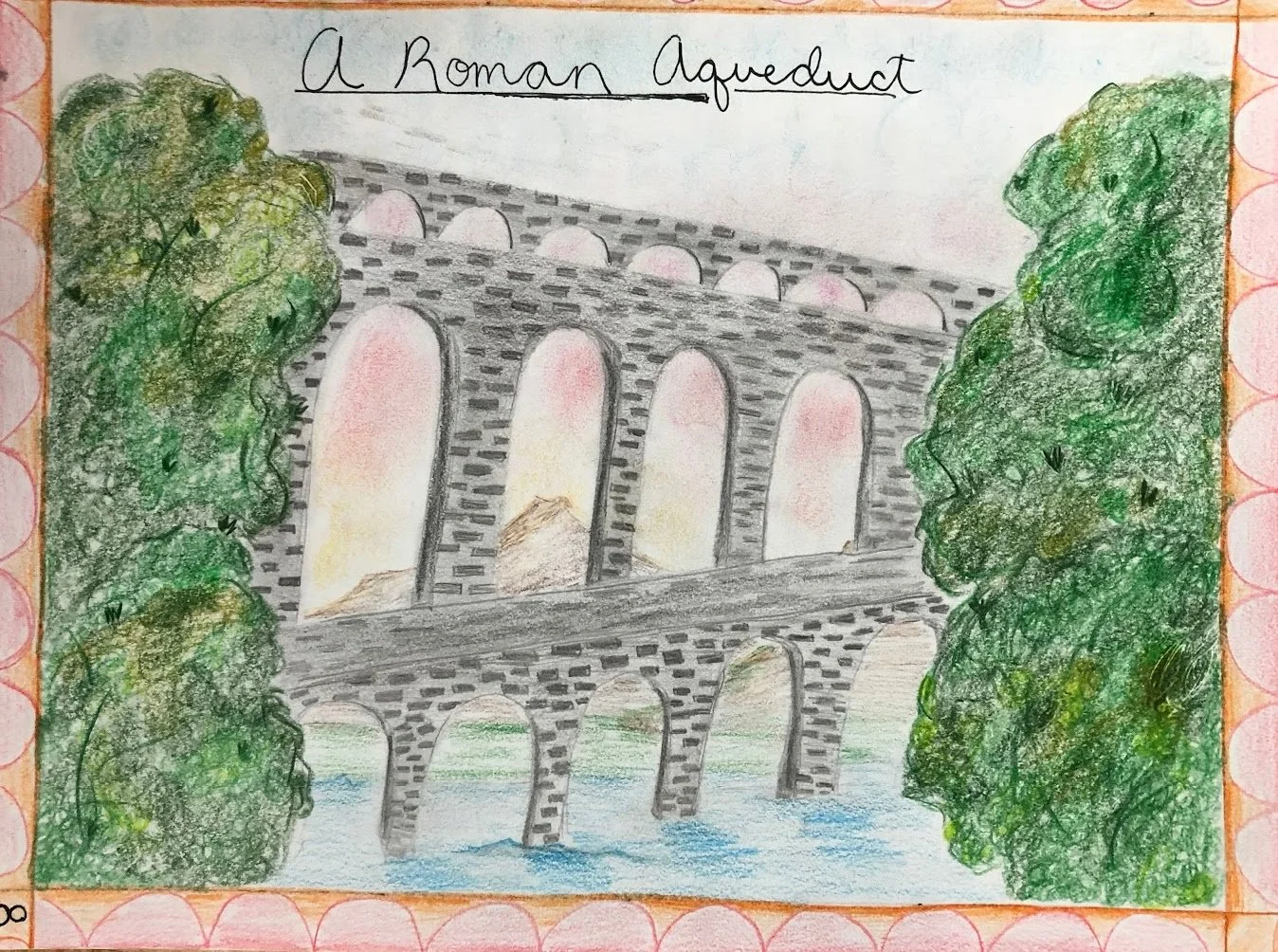
A pencil drawing from a sixth grader’s main lesson book- Roman history coming to life!
But in Waldorf education, art is naturally incorporated into each subject- it is not a separate subject, it is the mechanism used to explore, study, and understand everything!
So, what does this art curriculum really look like in the upper grades?
For example, in seventh grade, students explore the Renaissance and all the discoveries, inventions and artistic movements that arose from that time. Instead of just listening to the biographies of great artists such as Michaelanglo, Raphael, or da Vinci, the students will copy their works of art in detail: a masterclass in figure drawing! Though history may be the focus, students engage with the curriculum through their own artistic endeavors.
The skills built through seventh grade figure drawing lead directly into the next grade’s curriculum. In eighth grade, students explore the human body in an Anatomy block. They will learn about muscles, the nervous system, how various organs function, and much more. Skills in figure drawing will grow all the more through this block; drawing a human hand with the knowledge of its skeletal and muscular structure creates a deeper connection to the beauty and function of the human body. It’s artistic work supporting scientific study!
As well, the upper grade student studies Physics from sixth through eighth grade, which includes exploring light and all its properties. The perfect art medium to deepen one’s study of light is charcoal. Drawing with charcoal encourages a student to really observe light and how it travels, reflects, bounces, and highlights an object, and how the lack of light creates shadow and depth. Drawing light and darkness in an accurate, beautiful way requires the understanding of light itself- once again, art and science working as one!

Stunning charcoal drawings from a seventh grade Waldorf classroom- we especially love how each has their own style and personality.
The actual outcome of the final piece of art is of secondary importance to the process of creating and exploring connections. The act of creating the art is a process which supports their learning.
Truly, art is woven throughout the upper grades; here are some examples:
Pencil Drawings- Found in geometry forms, nature sketching, physiology and anatomy diagrams, mathematical proof work, astronomy observational notes and more! Pencil drawings are also the predominant art medium used in creating main lesson books.
Perspective Drawing- A skill learned most often in seventh grade, sometimes in its own short block. The process of perspective drawing to show depth and distance is used in studying the Renaissance, architecture, geological landscapes, astronomy illustrations and observations, and more.
Charcoal Drawing- Commonly introduced in sixth grade, this artistic medium is used throughout the upper grades, especially to study and illustrate the properties of light in physics and chemistry blocks. As well, charcoal drawing is used for portrait drawing or historical figures, detailed human anatomical studies, art-history inspired works, and more!
Watercolor Painting- Though this art medium is done more often in the lower grades, middle school students will continue to engage with watercolor painting on a regular basis! From botany paintings of flowers, to a colorful volcanic eruption of red and oranges, painting connects to nearly every aspect of the curriculum.
Clay Work- Working with clay is a powerful, sensory experience for the middle school student. It encourages the student to build and create from a new, 3D perspective, which is very different from many of the art mediums they have become familiar with thus far! Students may sculpt the bones of a human leg, a Roman aqueduct, an example of layers of sedimentary rock, a bust of a historical figure, and more.

Students often work with clay in the eighth grade as they study the Platonic Solids, and elsewhere in the upper grades too!
The list could go on and on! Truly, there are no bounds around how art can be used as a tool for learning in the upper grades.
Art is in everything, and an essential cornerstone to all the curriculum studies of the upper grades student.
Looking to bring Waldorf upper grades art curriculum into your homeschooling routine?

About the Authors
Robyn Beaufoy is Waldorfish’s CEO, and a course instructor for two of our courses - Waldorf Art for Beginners and Weekly Art Foundations. You’ll find her intuitive touches and influences throughout everything Waldorfish offers! Robyn has been in the world of education for almost 30 years, with an MA in Education and a certification in Waldorf teaching - she also homeschooled both of her children. In 2012 Robyn co-founded Waldorfish.com, creating it with the vision of making Waldorf inspired-art and pedagogy more accessible, joyful, and doable to homeschoolers all over the world.
Caitlin Amajor is Waldorfish’s course instructor for Geometry grades 5 & 6, and Botany, as well as our Administrative Assistant. From a young age, Caitlin has been immersed in Waldorf education, attending a Waldorf school from K-8. After receiving a BA in History, Caitlin gained her certification in Waldorf teaching, and spent seven years as a Waldorf class teacher in the upper grades. With a special fondness for watercolor painting and geometry, Caitlin loves bringing Waldorf education to her students all over the world, and seeing their own individuality and style bloom from the curriculum!

Is Waldorf Botany Academic as Well as Artistic?
Q: Is the Waldorf Botany curriculum academic?
(This post is part of a series in which we answer the most common questions we receive in our inbox re: homeschooling, Waldorf curriculum/pedagogy, and whatever else comes our way! Click here to read more from the series!)
A: A frequent misconception that we run into is that science and art cannot walk hand in hand. However, in Waldorf education, the two meld together to create a curriculum that is beautiful, deep, and academic!
Waldorf botany lessons include art, storytelling, and hands-on learning, all through the lens of scientific exploration.
Botany is usually taught in two separate blocks (to learn more about why, click here!) and each is imbued with scientific study in different ways.
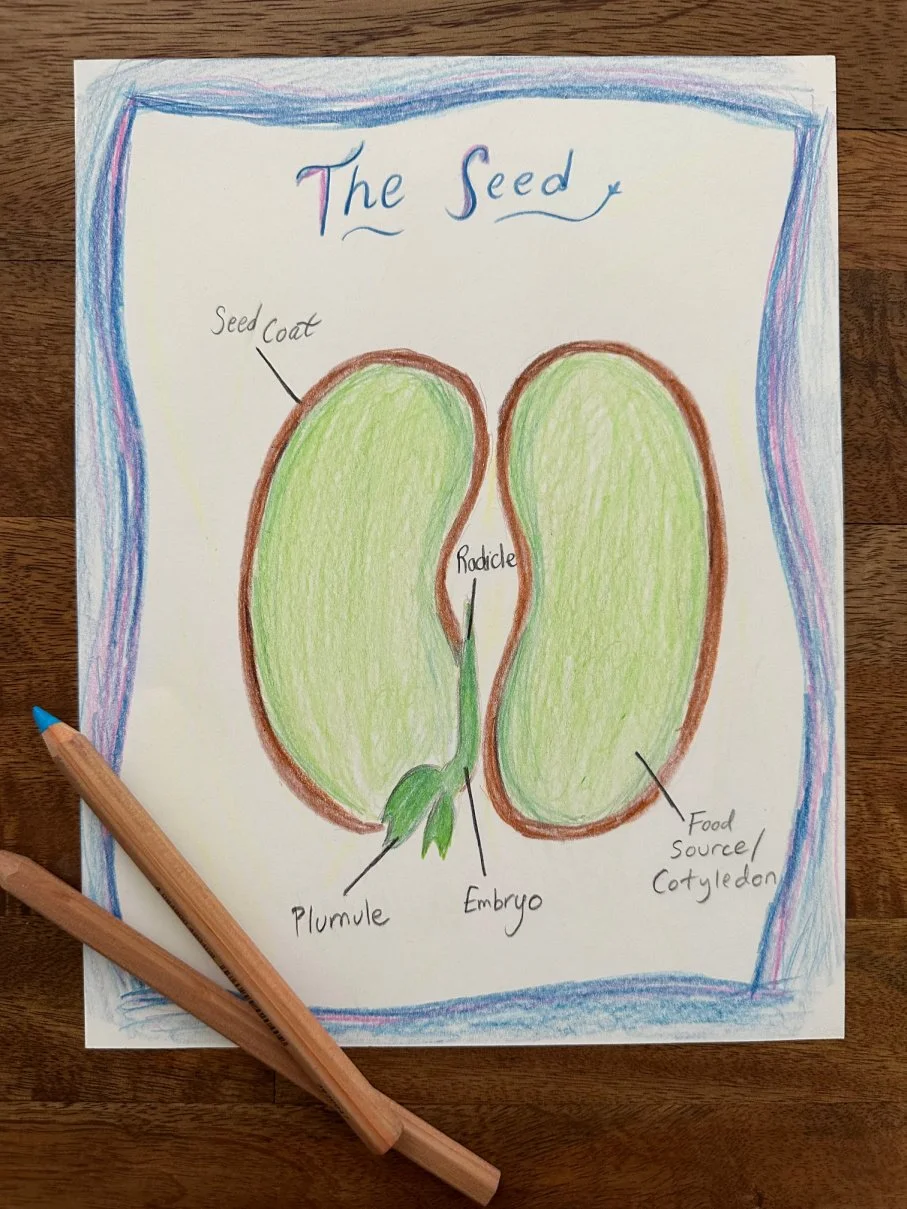
A main lesson book page illustrating the inner structure of a seed- with plenty of color, of course!
The first block explores the “lower plants”- such as lichen, moss, ferns, and algae- and these plants are explored through the use of storytelling and artistic imagery. In this block, the educator is not focusing on the more complex aspects of these plants, but instead painting the picture of how these seemingly ‘simple’ plants live, thrive, and play important roles in the health of our planet.
In the first block, students explore the lower plants through imagery and imagination, while weaving in the science of the plants as well.
For example, the educator may tell the story of algae, while including that algae has no stem or real roots, cannot stand on its own, and provides much of the oxygen for all living things on earth. Through story, the child builds an understanding of algae as a living, beautiful, and essential plant.
The second Botany block, often taught later in the school year, is taught in similar ways to the first, though here, the educator brings in the method of phenomenology. (In short, phenomenology is the process of learning through doing and observation.)

The process of photosynthesis illustrated on a main lesson book page!
As the child has been growing throughout the year, by spring they are typically ready for a more complex curriculum, and ready to see plants in a new way!
Expanding upon the first block’s studies, the more complex plants are now explored: from seeds, to germination, photosynthesis to blossoms, and pollination to seed dispersal, the second block is a robust, more detailed study of the plant world.
The educator still uses art and storytelling (and will throughout eighth grade and beyond!) but they also bring in more opportunities for the student to observe, come to their own conclusions, and explore how plants grow and reproduce in a real way.
For example, learning about seeds will take a variety of forms. The educator may tell the story of the little seed waiting to sprout, and how it holds all the promise of what it will become within- even the smallest seed holds all of the potential to grow into a mighty Sequoia tree- it just needs a bit of help from air, water, and light!
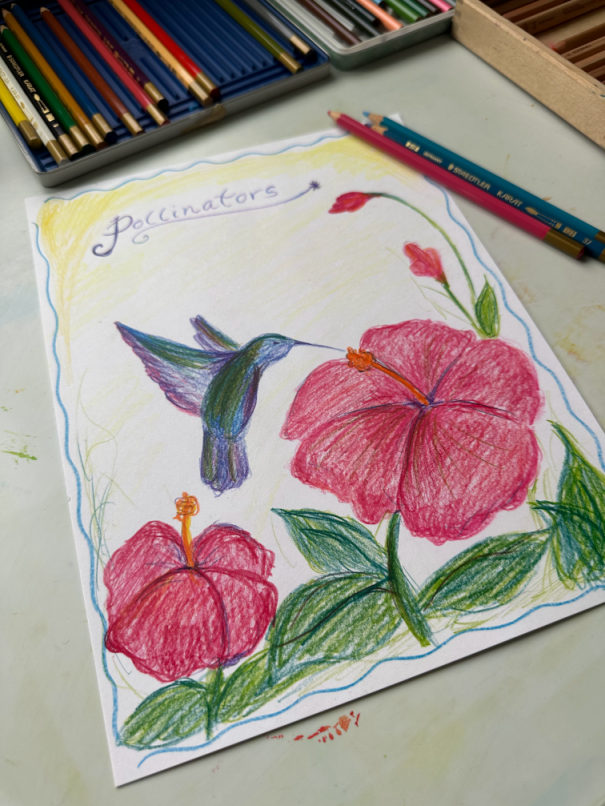
The story of pollinators represented in one drawing- a perfect opportunity for students to combine science and art!
As well, the educator will bring in hands-on demonstrations, such as sprouting seeds on a windowsill, and dissecting a seed to see what’s inside.
What seeds sprout more quickly? Under what conditions? How do the sprouts differ from one type of seed to another? Can we observe the energy reserves of the seed, and what parts will sprout into the first leaf and root once it germinates?
Using this approach, the educator guides the children into seeing the plant in its entirety and its parts; how plants are not only beautiful, but how they function, and how the individual parts of a plant each have essential roles in making the plant whole.
Waldorf Botany curriculum is a wonderful example of how art, storytelling, and science can meld together to become a rich academic learning experience for the child!
Enjoy!

About the Authors
Robyn Beaufoy is Waldorfish’s CEO, and also a course instructor for Simple Season (coming soon!), Waldorf Art for Beginners, and Weekly Art Foundations. You’ll find her intuitive touches and influences throughout everything Waldorfish offers. Robyn has been in the world of education for over 25 years, with an MA in Education and a certification in Waldorf teaching - she also homeschooled both of her children for some of that time. In 2012 Robyn co-founded Waldorfish.com, creating it with the vision of making Waldorf inspired-art and pedagogy more accessible, joyful, and doable for homeschoolers all over the world.
Caitlin Amajor is Waldorfish’s course instructor for Geometry grades 5 & 6, and Botany, as well as our Administrative Assistant. From a young age, Caitlin has been immersed in Waldorf education, attending a Waldorf school from K-8. After receiving a BA in History, Caitlin gained her certification in Waldorf teaching, and spent seven years as a Waldorf class teacher in the upper grades. With a special fondness for watercolor painting and geometry, Caitlin loves bringing Waldorf education to her students all over the world, and seeing their own individuality and style bloom from the curriculum!

What is Waldorf First Grade Curriculum for Art?
Q: What is the Waldorf first grade art curriculum?
(This post is part of a series in which we answer the most common questions we receive in our inbox re: homeschooling, Waldorf curriculum/pedagogy, and whatever else comes our way! Click here to read more from the series!)
A: If you’re just getting started with your homeschooling journey, you’re probably thinking about how you’ll bring the Waldorf first grade art curriculum into your rhythm.
We’ve put together this piece as a starting place for you - we’ll be answering frequently asked questions about Waldorf art in first grade, and providing you some helpful resources to help make your artistic journey doable, meaningful, and fun!

What does the Waldorf art curriculum include in first grade?
In Waldorf education, first grade is a pivotal milestone in a child AND educator’s educational and developmental journey. Amongst the newness of the grade (from academics, to daily routine, to social dynamics) art is incorporated into nearly every aspect of the curriculum (to learn more about the role of art in education across all the grades in Waldorf curriculum, click here!)
Each family and school will vary their art curriculum, but generally, a first grader will enjoy experiences with wet-on-wet watercolor painting, form drawing, pencil and crayon drawing, and the joy of learning through storytelling.
How is chalk art used in first grade?
In Waldorf first grade classrooms, chalk art is a tool used by the educator to enliven and enhance the curriculum through pictures. The drawings change frequently, and usually relate to the subject being studied or the season at hand.

The letter “G” for goose- all in one image!
In a first grade classroom, one might observe the drawing of a goose combined with the image of a letter G (see an example to the right!) and the story of the day may be the fairy tale of the golden goose. Together, the image and the story work to enliven the language arts lesson for the children as they get to know the letter G!
At this point, chalk drawing is a medium generally used only by the educator, and one that provides endless possibilities in bringing the curriculum to life on the chalkboard. To learn more about chalk drawing and the role it plays in Waldorf education, click here.
How is Waldorf watercolor painting introduced in first grade?
A particular style of watercolor painting, often referred to as wet-on-wet painting, is practiced throughout the grades in Waldorf schools, though most often in the lower grades, 1-4. This technique of painting involves using liquid watercolor pigments on damp paper. The resulting effect is paintings that are saturated in color and unique to each artist.

Watercolor paintings from our first grade course- each is different and unique!
In grade one, the lessons are simple color experiences guided by the teacher. It is purely artistic work - there is no expectation of the children creating a specific form or picture of something. Colors are introduced slowly and individually, giving the children plenty of time to enjoy and experience the color inwardly and deeply. To learn more about the pedagogical foundations of Waldorf first grade watercolor painting, click here.
What is form drawing?
Form drawing is a practice which allows children (and adults!) to engage with space, balance, and symmetry through drawing. In first grade, form drawing starts with simple basics, as we are just introducing the child to the world around them. Form drawing also provides foundational exercises that support handwriting, pencil grip, and much more.
You’ll often see the children’s exploration of straight and curved lines hanging on the walls in Waldorf first grade classrooms. The children are guided through the practice of drawing straight and curved lines on the chalkboard, paper, in sand, even in the mud, etc. Building in a variety of layers of experience helps the child's body internalize the movements more deeply.
Though it may seem simple, what the first grade begins to discover is that straight and curved lines are in everything, building connections with their environment and natural world around them. To learn more about first grade form drawing, click here.
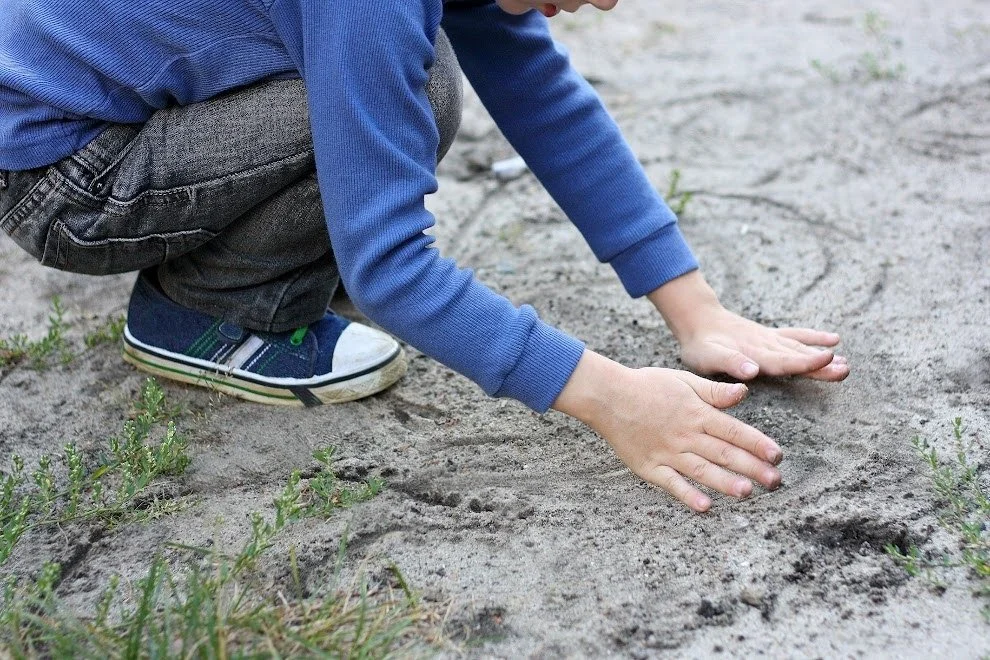
Form drawing can be done inside, outside, or wherever inspiration strikes!
How do I incorporate form drawing into the first grade?
Form drawing is best done as a regular practice in a child’s daily rhythm. Shorter, but regular sessions truly allow the various forms (and the process to create them!) an opportunity to deeply integrate into the child’s body and soul.
To really make something a part of your daily practice (ten to fifteen minutes per day is ideal!), put it on the calendar, follow through, and be intentional. Soon, the routine will become second nature, and you will truly reap the benefits that rhythm provides. (To learn more about Waldorf form drawing, click here!)
What is the significance of storytelling in Waldorf education?
Storytelling is an important tool in Waldorf education, especially in the lower grades! The Waldorf curriculum is rich in story, from nature stories and fairy tales, form drawing stories, through great myths and legends, to biographies and historical stories.
Oftentimes, stories are told orally, or without the use of a book or notes. It’s a way of connecting with the child, storyteller to listener, and allowing the content to come alive in a rich and organic way. When we don’t rely on the written word, the storyteller is able to tailor the story to the needs of the child. Though you may not know it, you already are a storyteller – you can get started right away with bringing stories into your regular routine! Click here to learn more!
How do I get started with Waldorf art?
First and foremost- get your supplies in order!
One of the early hurdles of getting started with Waldorf art is the question of supplies- what to buy, where to buy it, how much to spend, and how to use and care for everything! It’s easy to get caught up in buying the art supplies you think you should purchase (while spending a lot of money!) and then leaving it to collect dust on the shelf for fear of wasting it, using it incorrectly, or just not knowing how to use it.

Sound familiar?
So, start at the beginning, and get the support and resources you need right away! Our Waldorf Art for Beginners course was designed to walk you through the most commonly found artistic mediums in Waldorf education, including watercolor painting, crayon, and chalk drawing. This includes what to buy (and what not to buy!) how to care and store for everything, and then, how to use the supplies to create beautiful artwork.
Wanting to make Waldorf art a part of your weekly routine? Our Weekly Art Foundations course provides weekly lessons (enough for an entire school year!) that provides step-by-step instruction using Waldorf art techniques.
Use your resources! Head to our blog post Starting Waldorf First Grade to find all of our resources on art, storytelling, Waldorf pedagogy, and more.
Whew! Ok, it’s time to jump in and explore
Questions? You can connect with us here - we’re happy to help.

About the Authors
Robyn Beaufoy is Waldorfish’s CEO, and a course instructor for two of our courses - Waldorf Art for Beginners and Weekly Art Foundations. You’ll find her intuitive touches and influences throughout everything Waldorfish offers! Robyn has been in the world of education for almost 30 years, with an MA in Education and a certification in Waldorf teaching - she also homeschooled both of her children. In 2012 Robyn co-founded Waldorfish.com, creating it with the vision of making Waldorf inspired-art and pedagogy more accessible, joyful, and doable to homeschoolers all over the world.
Caitlin Amajor is Waldorfish’s course instructor for Geometry grades 5 & 6, and Botany, as well as our Administrative Assistant. From a young age, Caitlin has been immersed in Waldorf education, attending a Waldorf school from K-8. After receiving a BA in History, Caitlin gained her certification in Waldorf teaching, and spent seven years as a Waldorf class teacher in the upper grades. With a special fondness for watercolor painting and geometry, Caitlin loves bringing Waldorf education to her students all over the world, and seeing their own individuality and style bloom from the curriculum!

A Guide to Finding the Right Course from Waldorfish.com
Q: I’m new to Waldorf homeschooling and I’d like to incorporate your courses; what should I choose?
(This post is part of a series in which we answer the most common questions we receive in our inbox re: homeschooling, Waldorf curriculum/pedagogy, and whatever else comes our way! Click here to read more from the series!)
A: First off, welcome! We’re so glad you’re here!
We offer courses crafted by master teachers, all designed with the Waldorf pedagogy and the homeschooling family in mind. Our courses are suitable for a wide range of ages, grades, and abilities, and include subjects in art, science (physics, chemistry, and botany), form drawing, geometry, and festival life.
So, how do you know which one is best for you and your child?
First, it’s important to note that we do not offer a full curriculum for a specific grade, or as it is sometimes called, a “boxed curriculum”.
We offer courses in an à la carte fashion, meaning they are stand alone courses that focus on a certain subject or skill.
What does that mean for you?

A landscape drawing using block crayons.
It means you can use our courses to supplement and enhance your homeschool curriculum, and essentially plug-in our offerings where you feel they will serve your family the best!
A quick pep talk: just because you’ve chosen to homeschool, does not mean you have to do everything yourself! Really, you don’t! Take the time to identify your strengths and challenges, and find support where you need help.
One way to do this is with our courses.
So, which course should you start with?
Here are a few questions consider:
Are you looking for a grade-specific course, or something more general and designed for a wide range of ages? Do you plan to have children of various ages work together with one course?
Is your child in the lower, or the upper grades (grades 1-4, or grades 5-8 and beyond?)
As the adult educator, are you hoping to have your child working independently with the lessons, or are you hoping to take the course on your own and then present the material to your child? Maybe you envision working in tandem with your child through the lessons?
Are you hoping to begin the course right away? (All but one of our courses are open for enrollment year-round; our Weekly Art Foundations course has two enrollment windows a year- click here to join our newsletter and receive more info!)
Once you’ve asked yourself these questions, check out the chart below. You’ll find courses that overlap in various categories, and others that are more specific to a grade or age.
Where would you like the most support?
Click here or on the chart below to explore!
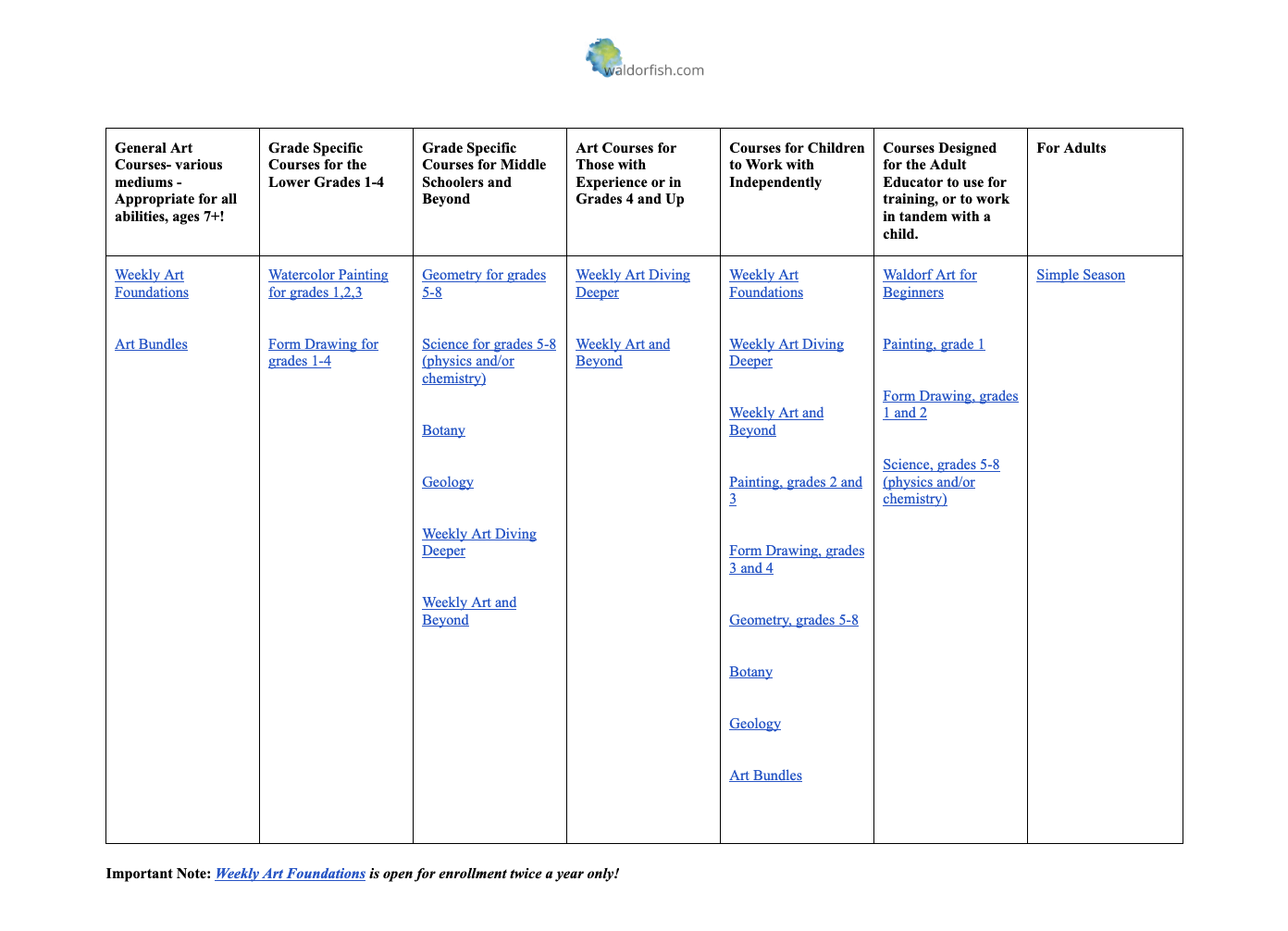
For all of our courses, you can expect:
Lifetime access (this means you can circle back to the lessons anytime - with younger children as they age up too!)
Instructor support
Detailed supply lists
Pedagogical and practical support ideas
Original courses inspired by Waldorf curriculum created by experienced, master teachers and home educators

Once you’ve identified where you’d like the most support, take some time to check out our Free Sample Lessons.
Each free lesson is pulled directly from the course itself- there is no better way to get an idea of the instructor’s style, a lesson’s pace, and overall, how our courses work!
There are a lot of options to choose from- if you’d like some help making the right choice, send us a message - we’re happy to help!
Enjoy, and we can’t wait to see what you choose!

About the Authors
Robyn Beaufoy is Waldorfish’s CEO, and a course instructor for two of our courses - Waldorf Art for Beginners and Weekly Art Foundations. You’ll find her intuitive touches and influences throughout everything Waldorfish offers! Robyn has been in the world of education for almost 30 years, with an MA in Education and a certification in Waldorf teaching - she also homeschooled both of her children. In 2012 Robyn co-founded Waldorfish.com, creating it with the vision of making Waldorf inspired-art and pedagogy more accessible, joyful, and doable to homeschoolers all over the world.
Caitlin Amajor is Waldorfish’s course instructor for Geometry grades 5 & 6, and Botany, as well as our Administrative Assistant. From a young age, Caitlin has been immersed in Waldorf education, attending a Waldorf school from K-8. After receiving a BA in History, Caitlin gained her certification in Waldorf teaching, and spent seven years as a Waldorf class teacher in the upper grades. With a special fondness for watercolor painting and geometry, Caitlin loves bringing Waldorf education to her students all over the world, and seeing their own individuality and style bloom from the curriculum!






Looking for something?

Welcome to Waldorfish! We started this adventure in 2012 out of a desire to make Waldorf training more accessible to class teachers in remote locations and to homeschooling families everywhere! Read more, click here.


WE WON! Our Weekly Art courses were voted “best interactive art program.” Learn more about the award, here.


Click here for a full list of schools we work with.
A few of our most popular blog posts:

Who are our courses for?

Starting Waldorf First Grade
4 Things to Know Before Planning Your Homeschool Year

In Praise of Balance: A Healthy Festival Life
Science in Waldorf Middle School: Starting Something New!